Created: 2024/07/13 15:46
Experiment no. 04
Experiment name: Determination of unit weight and voids in fine and coarse aggregate
Objective
- To determine the unit weight and % voids of fine and coarse aggregates using loose and compact methods.
Significance
- Provides necessary data for designing concrete mixes including selection of proportions.
- Helps in determining mass/volume conversion.
- Aids in optimizing material usage in construction.
Apparatus
- Tamping rod
- Balance
- Shovel
- Measure
- Sample aggregates: fine and coarse
Data sheet
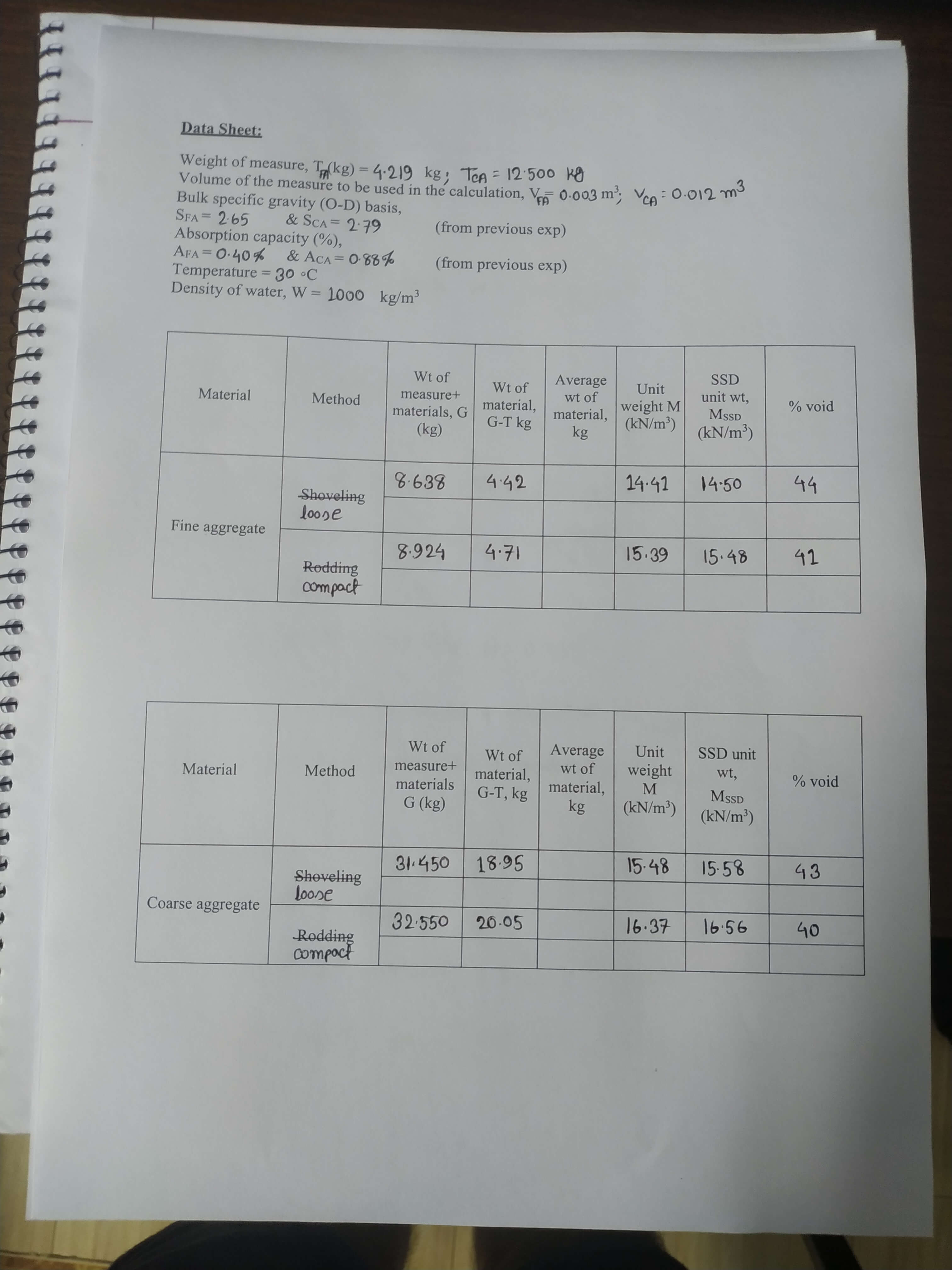
Calculation
Here,
- Density of water,
For fine aggregate
Here,
- Weight of measure,
- Volume of measure,
- Specific gravity,
- Absorption capacity,
- Weight of measure + materials,
- Weight of measure + materials,
Therefore,
In loose method:
- Weight of materials =
- Unit weight:
- SSD unit weight:
- % void:
In compact method:
- Weight of materials =
- Unit weight:
- SSD unit weight:
- % void:
For coarse aggregate
Here,
- Weight of measure,
- Volume of measure,
- Specific gravity,
- Absorption capacity,
- Weight of measure + materials,
- Weight of measure + materials,
Therefore,
In loose method:
- Weight of materials =
- Unit weight:
- SSD unit weight:
- % void:
In compact method:
- Weight of materials =
- Unit weight:
- SSD unit weight:
- % void:
Result
For fine aggregate, in both loose and compact method respectively, the unit weight is and , SSD unit weight is and , and % void is and .
For coarse aggregate, in both loose and compact method respectively, the unit weight is and , SSD unit weight is and , and % void is and .
Discussion
The experiment successfully determined the unit weight and % voids in fine and coarse aggregate using both loose and compact methods.
For both fine and coarse aggregates, the compact method results in a higher unit weight and lower percentage of voids compared to the loose method. These differences highlight the effect of compaction on aggregate density.
The SSD unit weight is slightly higher for both fine and coarse aggregates as it account for the absorption capacity, providing a more realistic measure for practical applications.
Understanding these properties helps in selecting appropriate aggregates for specific construction needs. Ensuring proper compaction during construction can improve the strength and durability of the resulting concrete mix.