ewce09.azraftaohid.me/L2T2/EWCE 262/Exp. 05 - Flow Over a V-Notch/Lab report.md
Created: 2025/01/12 21:51
Experiment No.: 05
Experiment Name: Flow over a V-notch
Objective
The objective of this experiment is,
- To determine the coefficient of discharge ().
- To plot actual discharge () against water surface height () on log-log graph paper to determine the value of exponent and calibration parameter .
- To determine the average coefficient of discharge from graph.
Scope
The v-notch weir produces higher head changes even for minor discharge changes, as a result it is applicable whenever small discharges are involved. It is used in,
- Measurement of flows in open channels such as drainage system, streams, canals, etc.
- Measurement of influent or effluent flows in wastewater treatment plants.
- Measurement of flows in natural streams or constructed channels.
- Measurement of flows in discharge systems for industrial processes.
- Use in laboratory experiments for study of fluid mechanics and for calibration of flow measurement devices.
Apparatus
The experiment involves the use of,
- V-notch weir
- Modular flow channel
Datasheet and graph
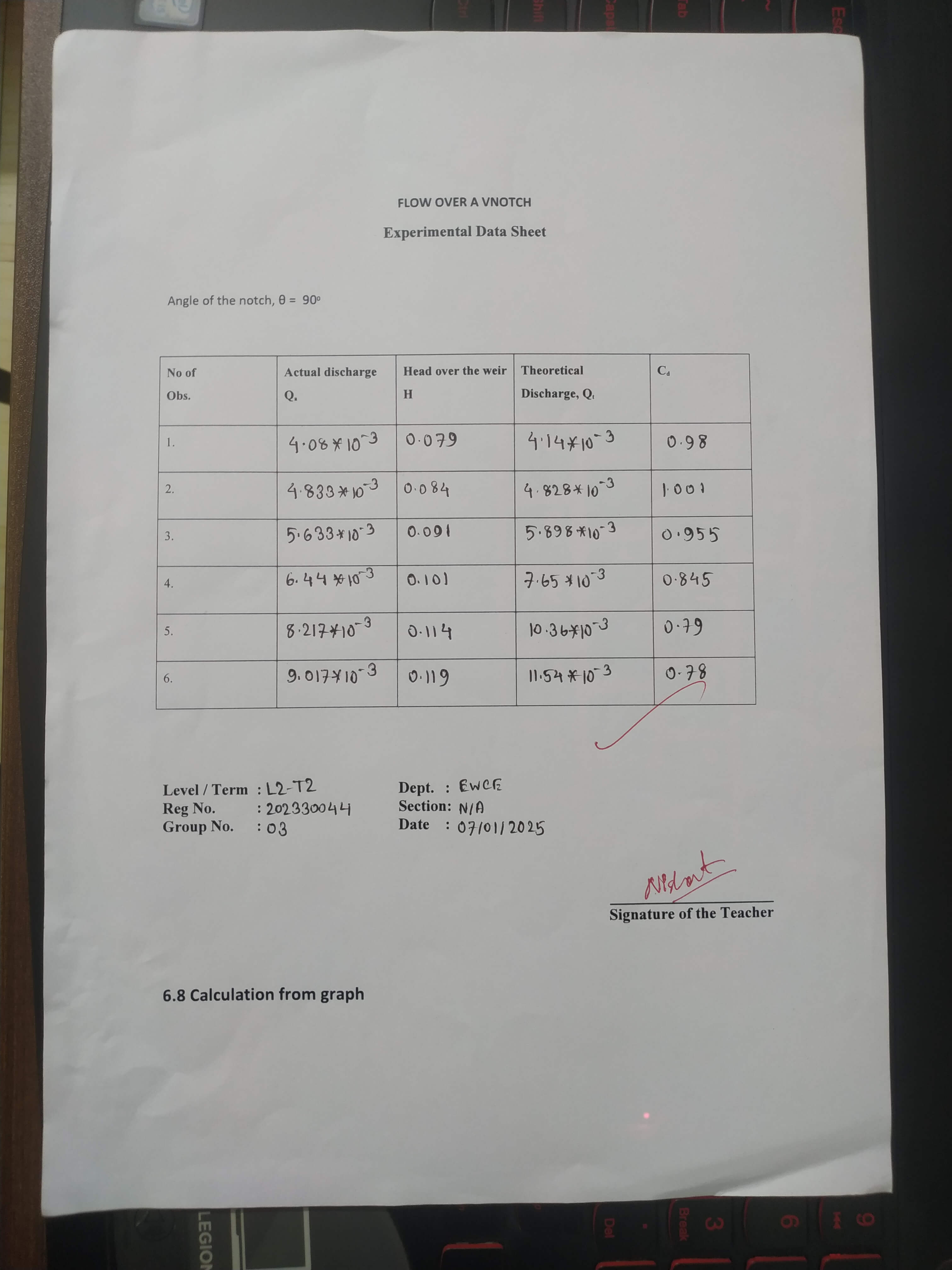
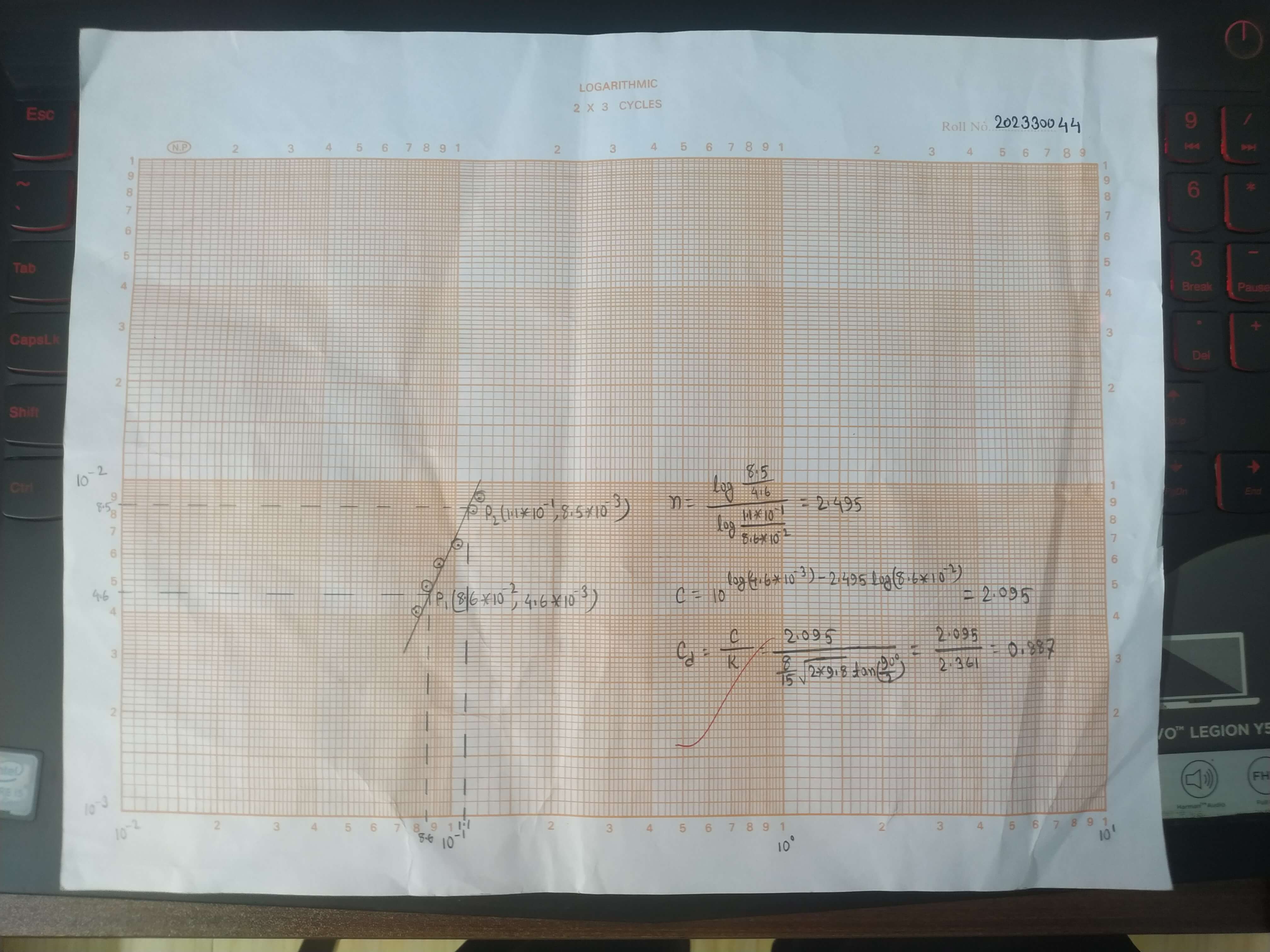
Calculation from graph
For the two points ( and ) on log-log graph, we get:
- ,
- ,
The exponent of can be calculated using the formula,
The calibration parameter can be calculated using the formula,
Applying the value of , and , we can get,
Now, the theoretical discharge is calculated using the formula,
The coefficient of discharge is calculated using,
Where,
The calibration equation is,
Comparing the equations and , we get average discharge coefficient,
Discussion
In this experiment, the average discharge coefficient () and the exponent of () for the selected v-notch weir were successfully determined. The values are and respectively. For future use of this weir, the actual discharge can be calculated by only measuring the water surface head :
The yielded value of is significantly higher than that of rectangular weir ( for our experiment), implying that the v-notch weir is more efficient. However, it is above the theoretical range of to due to reasons discussed towards the end. The measured is close to the theoretical value of , confirming the experiment's accuracy.
Importance of maintaining tail water level below the notch vertex and ventilation below the nappe
The tail water level (downstream water level) must remain below the vortex of the notch (lowest point of the notch) in order to:
- Avoid submergence: The v-notch weir is designed for water to flow freely over the notch without interference from downstream water levels. If the tail water level rises above the notch's vertex, it creates a submerged flow condition, invalidating the discharge equations.
- Accurate discharge measurement: The equation for measuring discharge over v-notch weir assumes that it only depends on the head of water above vertex. If tail water level interferes, it changes the flow behavior including effective the head, leading to inaccuracies.
In short, submergence flow compromises the experiment results by disrupting the expected flow profile of v-notch flow equations.
For accurate flow measurements, it is important to maintain adequate ventilation below the nappe on the downstream side. It should ensure that the nappe does not cling to the weir surface or form negative pressure zones which could cause to deliver more flow than actual.
- For a typical lab-scale experiment, the clear air gap may be 1–2 cm.
- For larger installations, it will depend on the flow condition and scale of the structure.
Why measure the water surface head at some distance upstream from the notch?
The water head measurement is made at some distance upstream from the notch in order to:
- Obtain true static head: As water approaches the notch, it increases its velocity. However, as per Bernoulli's equation, total head remains same, thus, as velocity head increases, static head must decrease. Hence, true static head is not found near the notch.
- Ensure uniform flow conditions: The notch and the contraction of the flow causes turbulence and disturbances to the flow. However, at some distance away, flow is more stable.
- Adhere to theoretical assumptions: The equation assumes that "free surface remains horizontal as far as the plane of the weir". However, the free surface drops as it approaches the weir.
In the case of v-notch, the minimum distance from the notch for measuring the head is at least four times the water surface height (). That is, if measured is , then the distance should be greater than .
Possible experimental errors
There are several potential sources of errors when performing this experiment:
- Measurement errors
- If the head is not measured at correct distance away from the notch (), measured head may be lower than actual head.
- There can be misreading of the scale due to parallax errors.
- Apparatus problems
- In our experiment, the weir had leakage causing water to flow from the sides. It may have introduced significant inaccuracies, potentially explaining the higher than average coefficient of discharge (more water flow leading to lower head, ergo, lower and higher ).
- If the v-notch shows deviations from the specified notch angle (), calculated result will be inaccurate.
- Environmental factors
- Variation in temperature affects fluid properties like viscosity and density.
- The equation assumes ideal flow condition, however, while minor, real fluids introduce some degree of inaccuracies.
Practice questions
1. What is the average value of for a v-notch? Does it depend on flow condition (partially or fully contracted)?
The coefficient of discharge () is the ratio between actual discharge and theoretical discharge. For a v-notch, it is typically between and without exceeding . It depends on flow condition — whether it is partially contracted or fully contracted.
In a fully contracted condition, the water flow contracts both horizontally and vertically as it approaches and passes through the notch. The value is stable and falls within the commonly accepted range since it adheres to the theoretical assumptions.
On the other hand, partially contracted flow introduces irregularities, causing value to increase or decrease depending on how the contraction is hindered, leading to deviations from theoretical values.
2. Determine the discharge of water over a triangular weir if the measured head is 0.623 ft.
For the given problem,
- Angle of the notch,
- Measured head,
Hence, the theoretical discharge,
For coefficient of discharge, , the actual discharge,