ewce09.azraftaohid.me/L2T2/EWCE 262/Exp. 06 - Fluid Friction in a Pipe/Lab report.md
Created: 2025/02/15 14:33
Experiment no.: 06
Experiment name: Fluid Friction in a pipe
Objective
The objective of this experiment is:
- To find frictional losses () in a pipe by measuring initial and final heads ().
- Establish an empirical relationship:
- Between head loss () and velocity () in the form by plotting vs. on a log-log graph paper.
- Between friction factor () and Reynolds number () in the form by plotting vs. on a log-log graph paper.
Scope
The scope of this experiment includes:
- Design of pipe network systems: The head loss from source to the point of interest is required to determine pipe diameter. This experiment gives an estimate of head loss due to friction per unit length of pipe.
- Energy efficiency: Understanding the frictional losses and by repeated experiments, the optimal flow rate for fluid transport can be determined.
- Troubleshooting: Sudden deviation from experimental values can hint into clogged pipes or improper flow conditions within the pipe network.
Datasheet and graph paper
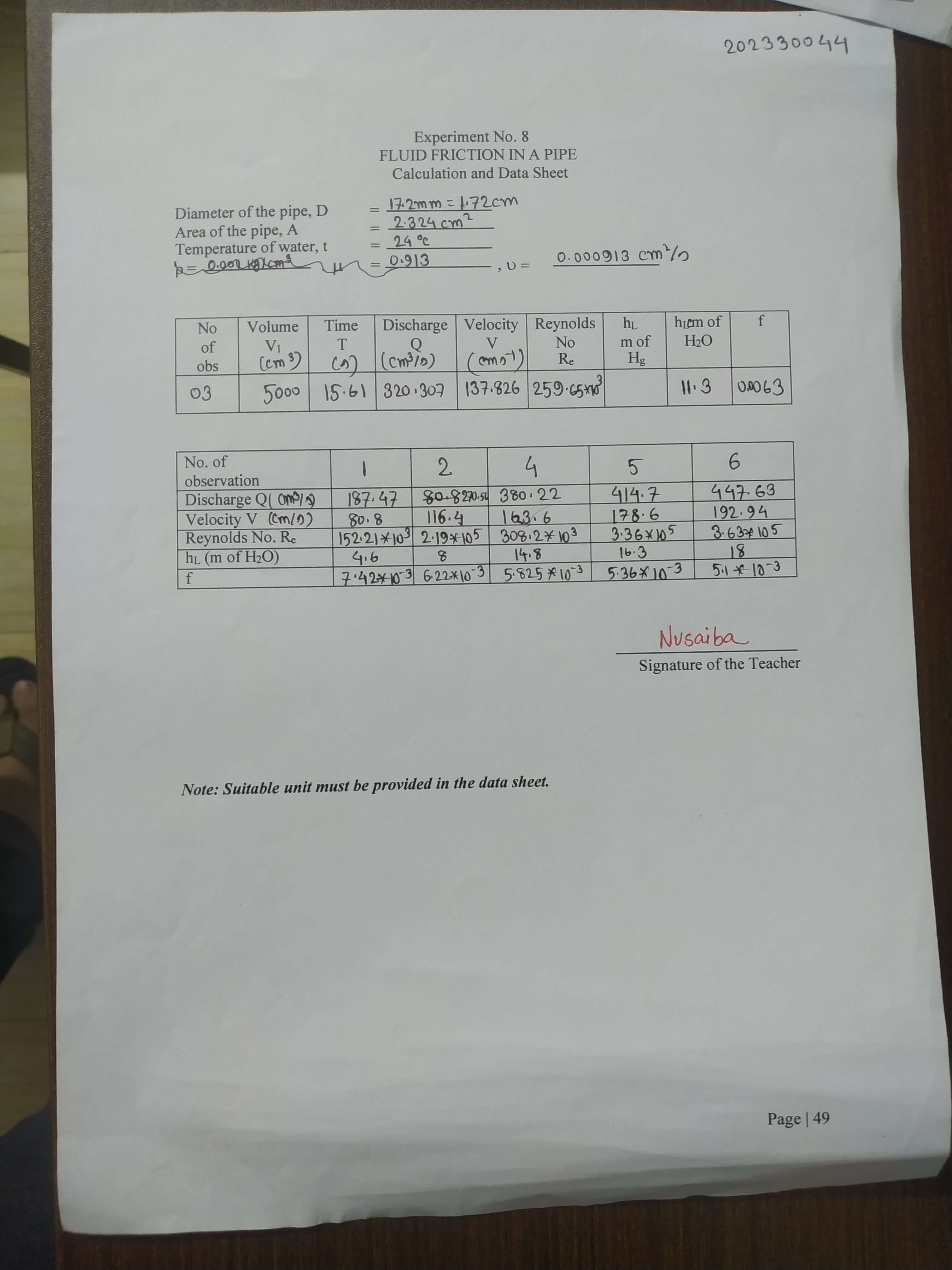
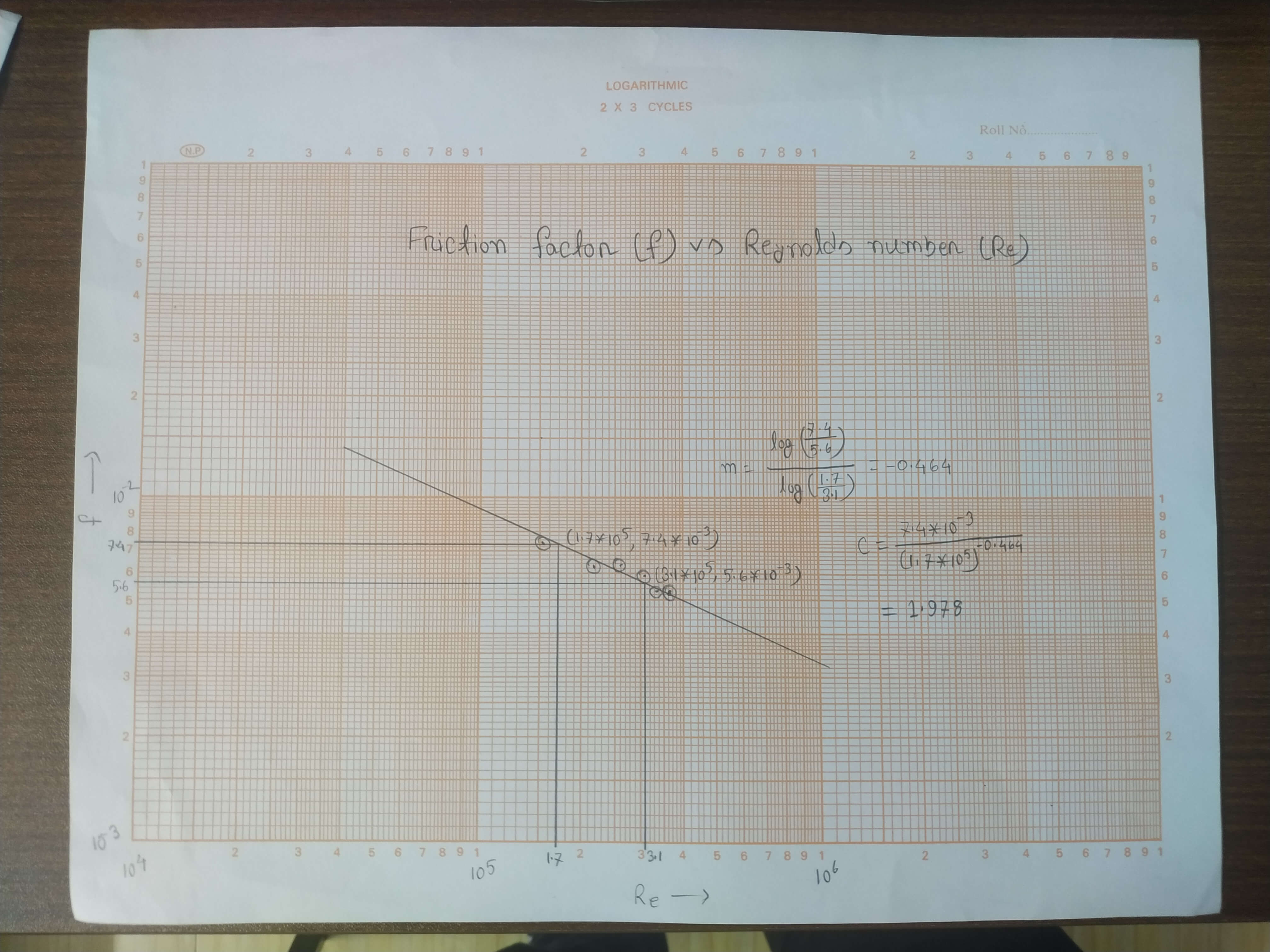
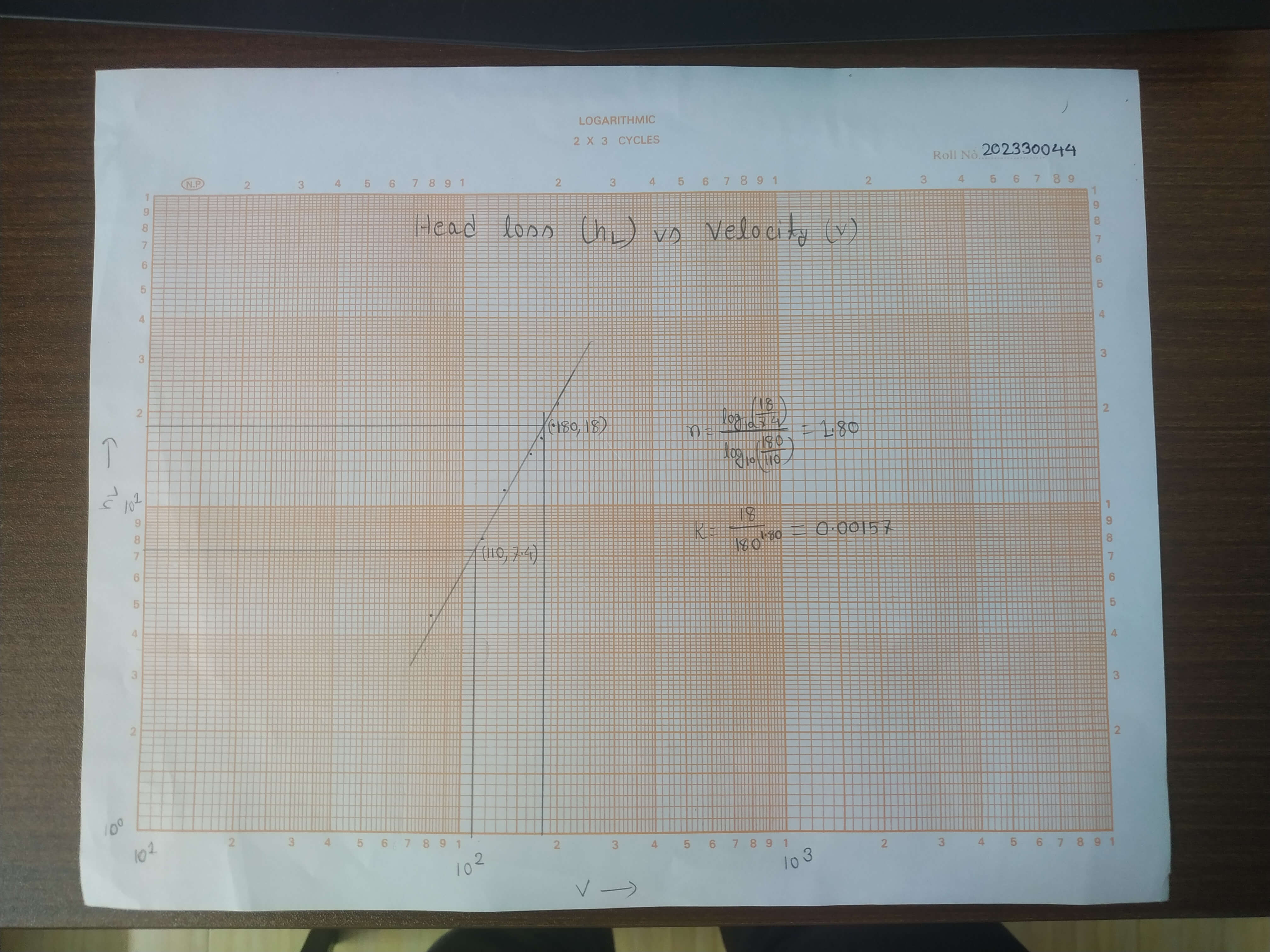
Calculation
| Component | Steps | Value |
|---|---|---|
| Discharge, | ||
| Velocity, | ||
| Reynolds number, | ||
| Head loss, |
From friction factor () vs. Reynolds number () graph, the determined value of:
And from head loss () vs. velocity () graph, the determined value of:
Discussion
In this experiment, fluid friction in a pipe was analyzed by determining two empirical relations between i) head loss () and velocity (), and ii) friction factor () and Reynolds number (). The empirically determined equations are:
- and
For head loss () vs. velocity () equation shows that head loss increases with velocity in a nonlinear manner. The exponent being close to indicates that the relationship follows the trend of Darcy-Weisbach equation which is for turbulent flow. This implies that higher velocity results in significantly higher head loss (almost square).
Similarly, for friction factor () vs. Reynolds number () equation shows that friction factor has an inverse power-law relationship with Reynolds number. The exponent being negative indicates that the relationship follows the trend of Hagen-Poiseuille equation. However, the equation dictates the theoretical value of being close to , which is significantly different from the value derived experimentally. This is due to the fact that the equation is valid for laminar flow while clearly our experimental setup produced turbulent flow. Nevertheless, this implies that friction factor increases as Reynolds number decreases for a flow. Correction: Blasius equation.
Both of the two relationships are useful for various practical applications such as pipeline designs where it is essential to estimate pressure losses and optimize flow. The determined empirical equations relate losses to velocity as well as Reynolds number.
Assignments
1. What are the factors upon which the frictional loss in a pipe depends?
Factors upon which frictional loss in pipe depends are:
- Velocity: Higher velocity means greater frictional losses.
- Pipe diameter: Smaller pipe diameter equates to larger frictional losses.
- Pipe length: Longer pipe constitutes to more frictional losses.
- Viscosity: Higher viscosity leads to higher frictional losses.
- Surface roughness: Rougher surface creates turbulent flow, and turbulent flows are prone to increased frictional losses.
2. What is meant by critical Reynolds number?
The critical Reynolds number is the Reynolds number () at which fluid flow transitions from laminar to turbulent. The Reynolds number ranges are:
- Laminar flow:
- Transitional flow: and
- Turbulent flow:
Hence, critical Reynolds number is between and .
3. What is a higher and lower critical point? Explain.
Lower critical number is the Reynolds number threshold that defines the transition from laminar flow to transitional flow. It is around . Below this value, flow is always laminar.
Higher critical number is the Reynolds number threshold that defines the transition from transitional flow to turbulent flow. It is around . Above this value, flow is always turbulent.
4. Write down the different types of losses that may occur in pipe flow.
In pipe flow, losses are categorized into major loss and minor loss.
Major loss: These occur due to friction between fluid and the pipe walls. Minor loss: These occur due to various disturbances including sudden expansion, sudden contraction, bends and curves, obstructions like gates and valves.
5. An oil (s= 0.85, v=1.8x10⁻⁵ m2/s) flows in a 10 cm diameter pipe at 0.50 l/s. Is the flow laminar or turbulent?
Flow type is determined by Reynolds number ():
Here,
- Flow rate,
- Pipe diameter,
- Kinematic viscosity,
Hence,
- Pipe cross section area,
- Flow velocity,
Therefore,
Since, is less than , the flow is laminar.