ewce09.azraftaohid.me/L2T2/EWCE 262/Exp. 07 - Co-efficient of resistance for change in cross section/Lab report.md
Created: 2025/02/18 00:42
Experiment no.: 07
Experiment name: Determination of co-efficient of resistance for change in cross section of pipe
Objective
The objective of this experiment is:
- To understand and determine head loss due to sudden expansion and contraction.
- To find the exponent and coefficient by plotting minor loss () vs velocity () due to contraction on a log-log graph paper.
- To find the exponent and coefficient by plotting minor loss () vs velocity difference () due to expansion on a log-log graph paper.
- To compare experimentally calculated result with theoretical expectations.
Scope
The scope of coefficient of resistance and this experiment includes:
- Sudden change in pipe diameter causes significant head losses. This experiment determines the coefficient of resistance () which is used to estimate head loss due to above conditions (Minor loss = ).
- Pipe network system can be optimized by understanding and analyzing the impact of cross sectional changes. The coefficient of resistance helps in determining pump power requirements to ensure sufficient pressure is present at endpoints.
Datasheet and graph
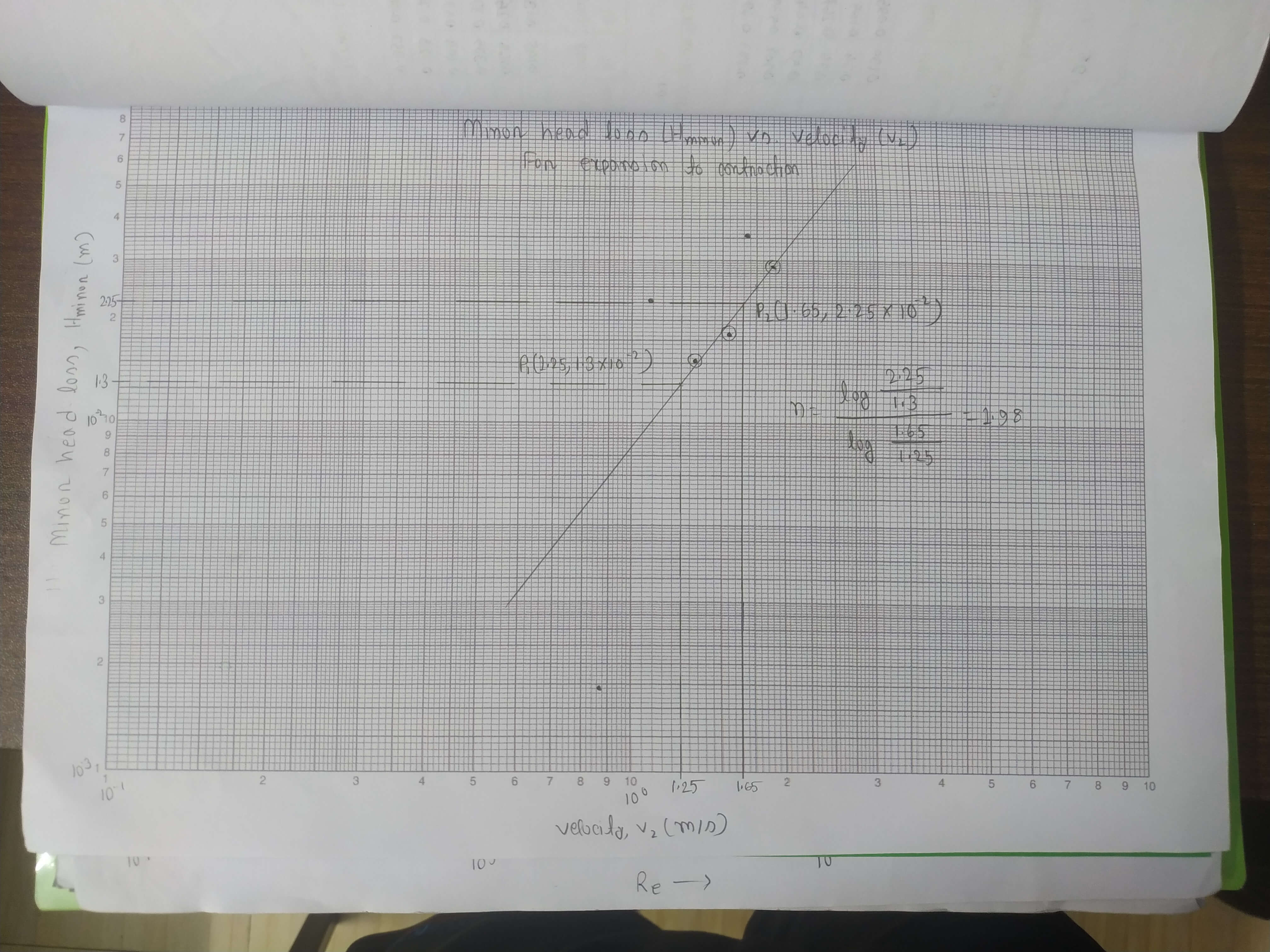
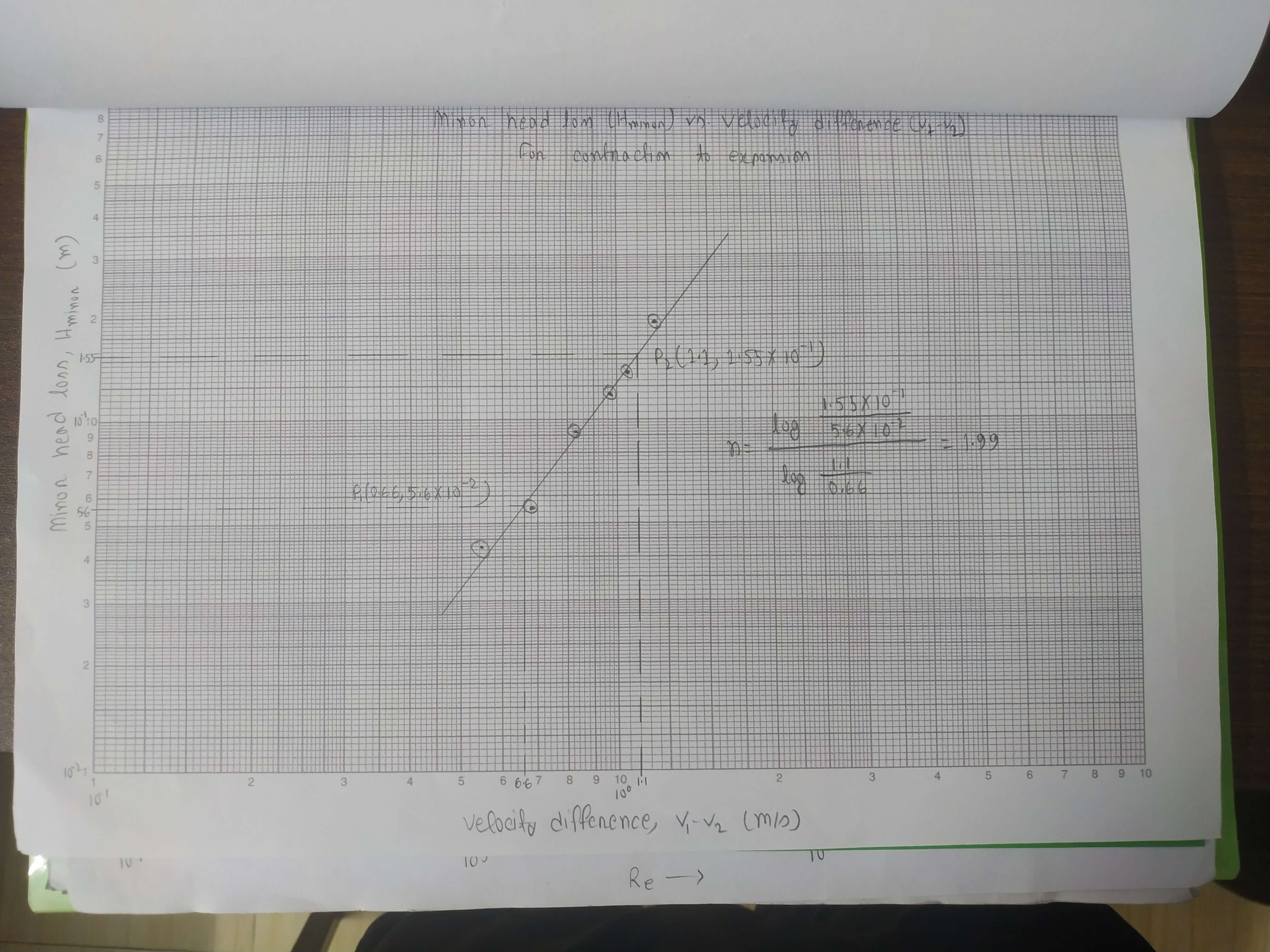
Calculation
For expansion to contraction:
| Component | Calculation | Result |
|---|---|---|
| Pressure head loss, | ||
| Actual discharge, | ||
| Velocity at expanded section, | ||
| Velocity at contracted section, | ||
| Reynolds number at expanded section, | 17417 | |
| Reynolds number at contracted section, | 28555 | |
| Friction factor at expanded section, | ||
| Friction factor at contracted section, | ||
| Velocity head at expanded section, | ||
| Velocity head at contracted section, | ||
| Major loss at expanded section, | ||
| Major loss at contracted section, | ||
| Major loss, | ||
| Head loss due to contraction, | ||
| Minor loss, | ||
| Coefficient of resistance, |
From two points ( and ) on graph, we get,
- ,
- ,
- Value of slope:
Value of coefficient can be calculated using the formula:
Replacing and , we get:
Now, the average value of coefficient of resistance:
Therefore, the expected value of is:
For contraction to expansion:
| Component | Calculation | Result |
|---|---|---|
| Pressure head loss, | ||
| Actual discharge, | ||
| Velocity at contracted section, | ||
| Velocity at expanded section, | ||
| Reynolds number at contracted section, | 28555 | |
| Reynolds number at expanded section, | 17417 | |
| Friction factor at contracted section, | ||
| Friction factor at expanded section, | ||
| Velocity head at contracted section, | ||
| Velocity head at expanded section, | ||
| Major loss at contracted section, | ||
| Major loss at expanded section, | ||
| Major loss, | ||
| Head loss due to expansion, | ||
| Minor loss, | ||
| Coefficient of resistance, |
From two points ( and ) on graph, we get,
- ,
- ,
- Value of slope:
Value of coefficient can be calculated using the formula:
Replacing and , we get:
Now, the average value of coefficient of resistance:
Therefore, the expected value of is:
Discussion
In this experiment, the value of coefficient of resistance for both expansion to contraction and contraction to expansion condition was determined. These values are:
- For expansion to contraction condition:
- For contraction to expansion condition:
These values can be used to determine minor loss in a pipe using the formula:
The value of for contraction to expansion condition being greater than the other condition indicates that energy loss is much greater when fluid flows from a smaller to a larger cross-section. Hence, in pipe design, it should be in mind to avoid creating such condition as less as possible.
Then an empirical relation between minor loss and velocity was determined. The relations are:
- For expansion to contraction condition: Here, corresponds to the velocity at contracted section.
- For contraction to expansion condition:
The value of the exponent for both conditions being close to assures that it follows the theoretical expectation. The same is observed for the value of coefficient in the case of expansion to contraction condition (actual: , expected: ). However, for contraction to expansion condition, it () deviates from expected value () by about a magnitude of three. This could be due to the reasons specified below.
Sources of errors
Potential sources of errors may include:
- There were inconsistencies in data from group 1, 2, and 5 that affected the trend in the graph. These points were excluded when constructing best-fit line in expansion to contraction condition.
- These inconsistencies may have been due to inaccurate readings of head loss caused by parallax errors.
- Delays when starting or stopping stopwatch to calculate discharge.
- It was observed that there were some bubbles within the pipe.
- It is possible that measuring equipment may have not been properly calibrated.
Practice problems
1. "For the same diameter ratios and the same velocities the loss due to sudden expansion is greater than the loss due to a corresponding contraction" Explain why?
Sudden expansion occurs when pipe diameter increases leading to greater cross section area and less flow velocity. This kinetic energy is partially converted into turbulence and heat, leading to greater energy dissipation and higher head loss.
On the other hand, contraction is when pipe diameter decreases leading to lesser cross section area and higher flow velocity. While it introduces flow separation and head loss, it is much less than for that of expansion. It is evident from the experiment that coefficient of resistance is higher for contraction to expansion condition, hence proving the point.
2. Math
Major head loss is determined by the formula:
Where, friction factor is:
Reynolds number is calculated using:
Assuming length of section 2,
| Section | L | Re | ||||
|---|---|---|---|---|---|---|
| 01 | 0.1 | 0.663 | 19890 | 0.027 | 0.00252 | |
| 02 | 1 | 1.322 | 28092 | 0.024 | 0.12588 | |
| 03 | 0.1 | 0.663 | 19890 | 0.027 | 0.00252 | |
| 0.13092 |