---
Created: 2025/03/04 00:51
---
# Experiment no.: 09
# Experiment name: Center of pressure
## Objective
The objective of this experiment is:
1. To determine the center of pressure for both vertical (0°) and inclined (30°) positions of the water vessel.
2. To calculate the resultant hydrostatic force acting on the submerged surface.
3. To verify the balance of moments about the center of motion and analyze why they differ.
## Scope
The scope of this experiment includes:
1. Understanding hydrostatic pressure distribution on submerged surfaces and its dependence on surface inclination.
2. Practical application includes:
1. Designing hydraulic structures (e.g., dams) that are to withstand hydrostatic forces.
2. Calculating overturning moments to ensure structural stability.
3. Validating theoretical formulas for the center of pressure and resultant hydrostatic force using experimental data.
4. Understanding the effect of surface inclination on the center of pressure and the magnitude of resultant force.
## Datasheet
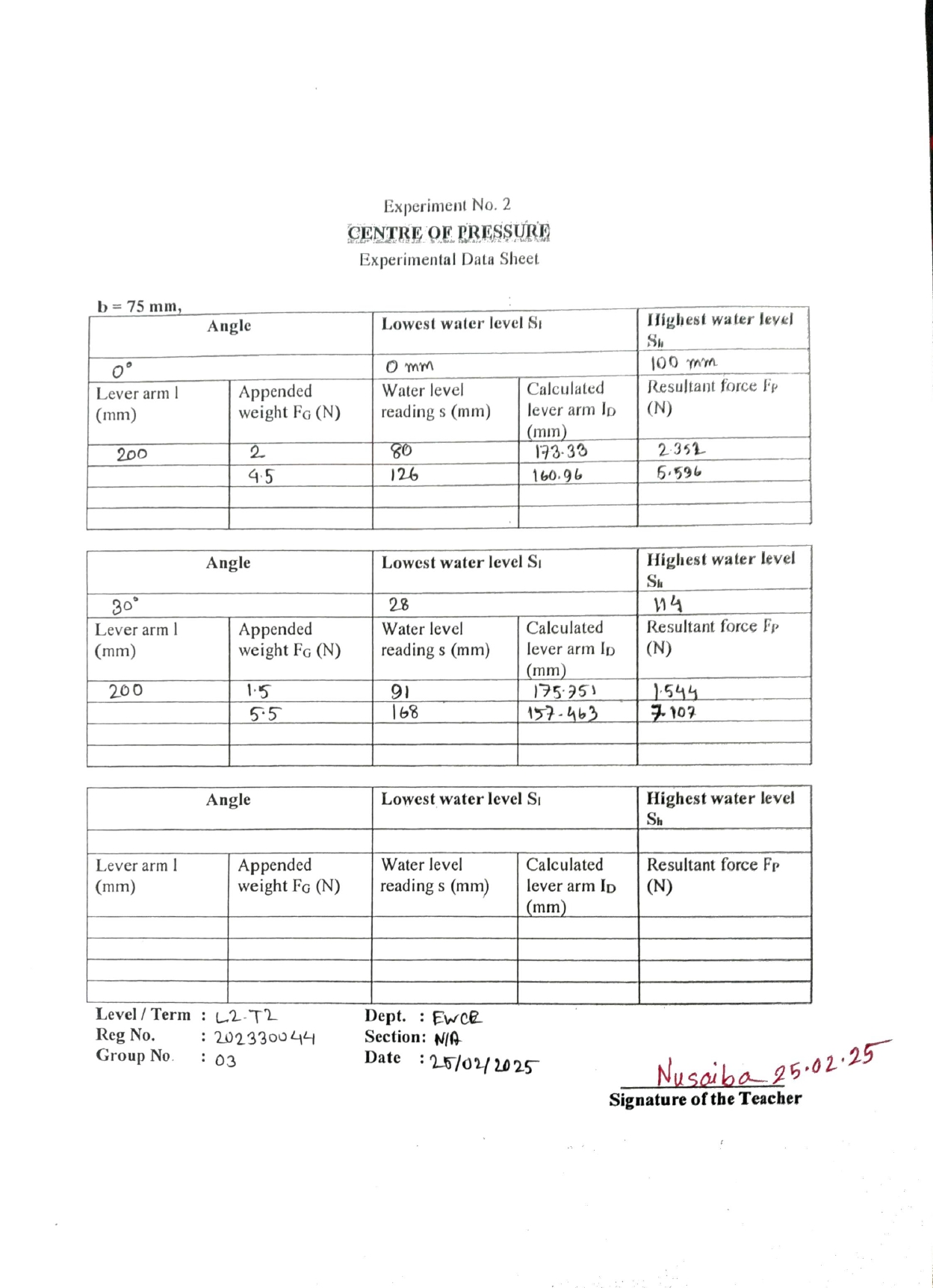
## Calculation
Given, width of vessel, $b = 75\space mm$
### Vertical positioning of the water vessel
Lowest water level, $S_l = 0\space mm$; highest water level, $S_h = 100\space mm$$
**Measure 01:**
Measured data:
1. Lever arm, $I = 200\space mm$
2. Appended weight, $F_G = 2\space N$
3. Water level reading, $s = 80\space mm$; \[$s \le s_h$\]
Hence,
Calculated lever arm,
$$
I_D = 200 - \frac{s}{3}
$$
$$
or,\space I_D = 200 - \frac{80}{3} = 173.333\space mm
$$
Hydrostatic pressure,
$$
P_c = \rho g\frac{s}{2}
$$
$$
or,\space P_c = 1000\times 9.8\times \frac{80\times 10^{-3}}{2} = 392\space N/m^2
$$
Active surface area,
$$
A_c = sb
$$
$$
or,\space A_c = 80\times 75 = 6000\space mm^2
$$
Resultant force,
$$
F_P = A_c\times P_c
$$
$$
or,\space 6000\times 10^{-6}\times 392 = 2.352\space N
$$
To verify balance of moments,
$$
y_p = F_P\times I_D = 2.352\times 173.333 = 407.680\space Nm
$$
$$
y_G = F_G\times I = 2\times 200 = 400\space Nmm
$$
**Measure 02:**
Measured data:
1. Lever arm, $I = 200\space mm$
2. Appended weight, $F_G = 4.5\space N$
3. Water level reading, $s = 126\space mm$; \[$s\gt s_h$\]
Hence,
Error,
$$
e = \frac{1}{12}\cdot\frac{100^2}{s-50}
$$
$$
or,\space e = \frac{1}{12}\cdot\frac{100^2}{126-50} = 10.965\space mm
$$
Calculated lever arm,
$$
I_D = 150 + e
$$
$$
or,\space I_D = 150 + 10.96 = 160.965\space mm
$$
Hydrostatic pressure,
$$
P_c = \rho g(s - 50)
$$
$$
or,\space P_c = 1000\times 9.8(0.126 - 0.050) = 744.800\space N/m^2
$$
Active surface area,
$$
A_c = 100\times b
$$
$$
or,\space A_c = 100\times 75 = 7500\space mm^2
$$
Resultant force,
$$
F_P = A_c\times P_c
$$
$$
or,\space 7500\times 10^{-6}\times 744.800 = 5.586\space N
$$
To verify balance of moments,
$$
y_p = F_P\times I_D = 5.586\times 160.965 = 899.150\space Nmm
$$
$$
y_G = F_G\times I = 4.5\times 200 = 900\space Nmm
$$
### Water vessel tilted
Angle, $\alpha = 30\degree$; Lowest water level, $S_l = 28\space mm$; highest water level, $S_h = 114\space mm$
**Measure 01:**
Measured data:
1. Lever arm, $I = 200\space mm$
2. Appended weight, $F_G = 1.5\space N$
3. Water level reading, $s = 91\space mm$; \[$s \le s_h$\]
Hence,
Active surface height,
$$
h = \frac{s-S_l}{\cos{\alpha}}
$$
$$
or,\space h = \frac{91 - 28}{\cos{30\degree}} = 72.746\space mm
$$
Error,
$$
e = \frac{h}{6}
$$
$$
or,\space e = \frac{72.746}{6} = 12.124\space mm
$$
Calculated lever arm,
$$
I_D = 200 - \frac{h}{3}
$$
$$
or,\space I_D = 200 - \frac{72.746}{3} = 175.751\space mm
$$
Hydrostatic pressure,
$$
P_c = \rho g(\frac{s - S_l}{2})
$$
$$
or,\space P_c = 1000\times 9.8(\frac{0.091 - 0.028}{2}) = 308.700\space N/m^2
$$
Active surface area,
$$
A_c = b\times h
$$
$$
or,\space A_c = 75\times 72.746 = 5456\space mm^2
$$
Resultant force,
$$
F_P = A_c\times P_c
$$
$$
or,\space 5456\times 10^{-6}\times 308.700 = 1.684\space N
$$
To verify balance of moments,
$$
y_p = F_P\times I_D = 1.684\times 175.751 = 295.965\space Nmm
$$
$$
y_G = F_G\times I = 1.5\times 200 = 300\space Nmm
$$
**Measure 02:**
Measured data:
1. Lever arm, $I = 200\space mm$
2. Appended weight, $F_G = 5.5\space N$
3. Water level reading, $s = 168\space mm$; \[$s\gt s_h$\]
Hence,
Error,
$$
e = \frac{1}{12}\cdot\frac{100^2}{\dfrac{s-S_l}{cos{\alpha}}-50}
$$
$$
or,\space e = \frac{1}{12}\cdot\frac{100^2}{\dfrac{168-28}{\cos{30\degree}}-50} = 7.463\space mm
$$
Calculated lever arm,
$$
I_D = 150 + e
$$
$$
or,\space I_D = 150 + 7.463 = 157.463\space mm
$$
Hydrostatic pressure,
$$
P_c = \rho g(s - S_l - 50\cos{\alpha})
$$
$$
or,\space P_c = 1000\times 9.8(0.168 - 0.028 - 0.050\cos{30\degree}) = 947.648\space N/m^2
$$
Active surface area,
$$
A_c = 100\times b
$$
$$
or,\space A_c = 100\times 75 = 7500\space mm^2
$$
Resultant force,
$$
F_P = A_c\times P_c
$$
$$
or,\space 7500\times 10^{-6}\times 947.648 = 7.107\space N
$$
To verify balance of moments,
$$
y_p = F_P\times I_D = 7.107\times 157.463 = 1119.090\space Nmm
$$
$$
y_G = F_G\times I = 5.5\times 200 = 1100\space Nmm
$$
## Discussion
The experiment successfully determined the distance of center of pressure from pivot ($I_D$) and resultant hydrostatic force ($F_P$) for both vertical (0°) and inclined (30°) positions of the water vessel. Afterwards, the balance of moments was verified, with experimental moments ($y_p$) closely matching the theoretical moments ($y_G$) for all cases.
**For $0\degree$ angle, when water level is $80\space mm$:**
- Calculated lever arm is 173.333 mm
- Resultant force is 2.352 N
- Moment around the center of motion is 407.680 Nmm
- Lever arm of appended weight is 200 mm
- Appended weight is 2 N
- Moment around the center of motion is 400 Nmm
**For $0\degree$ angle, when water level is $126\space mm$:**
- Calculated lever arm is 160.965 mm
- Resultant force is 5.596 N
- Moment around the center of motion is 899.150 Nmm
- Lever arm of appended weight is 200 mm
- Appended weight is 4.5 N
- Moment around the center of motion is 900 Nmm
From the above two observations, it is evident that the resultant hydrostatic force increases with water depth and surface area, demonstrating the dependence of hydrostatic forces on submerged geometry. The result also confirms that the location of center of pressure lies deeper than the centroid as $y_p$ > $y_G$ for vertical surface.
**For $30\degree$ angle, when water level is $91\space mm$:**
- Calculated lever arm is 175.751 mm
- Resultant force is 1.684 N
- Moment around the center of motion is 295.965 Nmm
- Lever arm of appended weight is 200 mm
- Appended weight is 1.5 N
- Moment around the center of motion is 300 Nmm
**For $30\degree$ angle, when water level is $168\space mm$:**
- Calculated lever arm is 157.463 mm
- Resultant force is 7.107 N
- Moment around the center of motion is 1119.090 Nmm
- Lever arm of appended weight is 200 mm
- Appended weight is 5.5 N
- Moment around the center of motion is 1100 Nmm
Similar to what was observed in inclined surface, the above two observations also confirms that the resultant hydrostatic force increases with water depth and surface area, and the center of pressure lies deeper than the centroid for inclined surface.
The close agreement between moment of hydrostatic force ($y_p$) and moment of the weight place on the pan ($y_G$) validates the accuracy of this experiment as well as the theoretical model for hydrostatic pressure calculations.
### Probable errors
The probable errors when performing this experiment includes:
1. Inaccurate readings of water depth, or angle due to parallax errors.
2. Minor water surface disturbances affecting pressure distribution.
3. Friction or misalignment in the apparatus affecting force readings.
4. Environmental factors such as temperature changes affecting water density or small vibrations disturbing the setup.
### $y_p$ is greater than $y_G$
Moment of hydrostatic force is greater than the moment of appended weight because:
- Hydrostatic force acts at the center of pressure, which is below the centroid of the submerged area. This increases the lever arm resulting in more moment (as moment increases with distance). Meanwhile, the appended weight acts at a fixed location.
- Hydrostatic force acts over the entire submerged area, and increases as depth is increased. Meanwhile, the appended weight is applied at a specific point.
## Assignment
**Discuss why the center of pressure is below the center of gravity for an inclined surface.**
The center of pressure is below the center of gravity (centroid) for an inclined surface because:
- Hydrostatic pressure increases with depth ($P = h\rho g$). Hence the lower portion of the surface experiences greater force than the upper portion. This shifts the resultant force downward.
- Pressure is distributed unevenly for inclined surface as opposed to what is observed on horizontal surfaces. This causes the center of pressure to be shifted downward for the inclined surface.
**What are the practical applications of the center of pressure?**
The center of pressure has several practical applications, including:
1. Design of hydraulic structure: It is used in the design of dams, gates, and similar structure to determine water pressure distribution and prevent overturning of the structure.
2. Ship design: It helps in understanding pressure distribution on the bottom portion of ship to ensure stability in water.
3. Water tanks and reservoirs: As depth is increased, more pressure is concentrated at the bottom portion of tanks and reservoirs. Hence, it must be ensure that bottom portion can withstand hydrostatic forces effectively.