An exhaustive analysis of all 6 past term-final examination question papers for EWCE 471: Coastal Engineering (formerly EWC 471: Basic Coastal Engineering), mapped against the official Section A (EWCE 471/SA/Lec *) and Section B (EWCE 471/SB/Topic *) lecture materials:
2022.pdf; Full Marks: 180; 30 marks/set)SA/ vs. SB/ Attribution)Across all six examination papers, the two faculty members teach distinct, well-defined halves of the syllabus:
EWCE 471/SA/ (Lec 01 to Lec 17-18 — Prof. Dr. Mohammad Asad Hussain / Prof. Dr. M. A. Alim's syllabus): Covers Introduction to Coastal Engineering & Bangladesh Coast, Wave Theory & Wave Mechanics (Airy / Linear, Stokes, Cnoidal, Solitary, Group Velocity, Subsurface Pressure, Statistical Wave Analysis), Wave Transformation (Shoaling, Refraction, Diffraction, Green's Law), Wave Breaking, Surf-Zone Currents, Wave Setup & Runup, Wave Forces on Vertical Walls & Piles (Miche–Rundgren / Sainflou, Minikin, Broken Waves), Storm Surge & Tsunami, and Coastal Morphology, Cross-Shore Beach Profile, Coastal Features (Tombolo, Barrier Spit, Barrier Island, Coastal Dune, Tidal Flats) & Estuaries.EWCE 471/SB/ (Topic 01 to Topic 08 — Simlia Satter Songi's syllabus): Covers Sea vs. Ocean & Coastal Features / SLR, Tides, Tidal Datum Levels, Tidal Bore & Tidal Cycles, Ports and Harbors (including Madras Harbor Layout & Littoral Drift Role), Coastal Processes, Erosion, Wetland Protection & Longshore/Cross-Shore Sediment Transport (), Deltas & Bangladesh Delta Plan (BDP) 2100, Tidal Theories (Newton's Equilibrium & Dynamical Theories, Moon vs. Sun, Priming/Lagging) & Tide Prediction, and Types, Functions, Failure Modes & Design of Coastal Structures (Quarrystone/Riprap Revetments & Seawalls).| Exam Paper | Exam Section A (Q1–Q4) |
Exam Section B (Q5–Q8) |
Attribution Notes & Exceptions |
|---|---|---|---|
| 2025 | SA/ (Lec 01 – Lec 17-18) |
SB/ (Topic 03 – Topic 08) |
Standard alignment: Exam Section A (Q1–Q4, Q1 compulsory) maps entirely to SA/; Exam Section B (Q5–Q8, Q5 compulsory) maps entirely to SB/. |
| 2024 | SA/ (Lec 03 – Lec 17-18) |
SB/ (Topic 02 – Topic 08) |
Standard alignment: Exam Section A (Q1–Q4, Q1 compulsory) maps entirely to SA/; Exam Section B (Q5–Q8, Q5 compulsory) maps entirely to SB/. |
| 2023 | SB/ (Topic 01 – Topic 07) |
SA/ (Lec 03 – Lec 17-18) |
Full Section Swap: In 2023, the two sections were swapped on the question paper — Exam Section A (Q1–Q4, Q1 compulsory) was set by the SB/ faculty (Topic 01 to Topic 07), whereas Exam Section B (Q5–Q8, Q5 compulsory) was set by the SA/ faculty (Lec 03 to Lec 17-18). |
| 2022 (July–Aug 2021) | SA/ (Lec 01 – Lec 17-18) |
SB/ (Topic 02 – Topic 08) |
Standard alignment: Exam Section A (Q1–Q4, Q1 compulsory) maps entirely to SA/; Exam Section B (Q5–Q8, Q5 compulsory) maps entirely to SB/. (In online mode, Q4 and Q8 Viva Voce were also compulsory). |
| 2021 (Feb 2021) | SA/ (Lec 01 – Lec 17-18) |
SB/ (Topic 02 – Topic 08) |
Standard alignment: Exam Section A (Q1 compulsory, choose 1 of Q2, Q3, plus Q4 online Viva) maps to SA/; Exam Section B (Q5 compulsory, choose 1 of Q6, Q7, plus Q8 online Viva) maps to SB/. |
| 2019 | SA/ (Lec 01 – Lec 17-18) |
SB/ (Topic 01 – Topic 08) |
Standard alignment: Exam Section A (Q1–Q4, Q1 compulsory) maps to SA/; Exam Section B (Q5–Q8, Q7 compulsory) maps to SB/. |
Note on Missing Lecture Folders in
EWCE 471/SA/: The syllabus table inSA/Lec 17-18/EWC471_lecture 17 and 18.pdf(p. 44) and the course outline inSA/Lec 01/EWC471_lecture 1.pdf(pp. 8–9) confirm that Lecture #2 (Coastal landforms, coastal diversity, coral reefs, secondary coasts) and Lectures #15–16 (Storm surge and Tsunami, wind stress, Langhaar shape, Ring of Fire, DART) are part of theSAcurriculum even though foldersLec 02andLec 15-16are omitted from the currentEWCE 471/SA/directory. Questions from those lectures (appearing in2019,2022, and2025 Q4c) are explicitly noted in the tables below.
All individual questions across the 6 past exams are ranked below by appearance frequency, along with their exact lecture/topic reference and page numbers (1-indexed PDF pages).
| Rank | Question | Frequency | Reference | Years |
|---|---|---|---|---|
| 1 | Wave Celerity () and Wavelength () Calculation Across Deep, Transitional & Shallow Water Depths Using small-amplitude (linear) wave theory, calculate the wave celerity () and wavelength () as a wave of given period () propagates shoreward from deep water across intermediate/transitional water to shallow water depths. |
6 | SA / Lec 05-06 (pp. 1–16) | 2019 (Q2c, Q4d), 2021 (Q1b), 2022 (Q1c), 2023 (Q5c), 2024 (Q2b, Q2c), 2025 (Q2b) |
| 2 | Local Fluid Velocities (), Accelerations (), Orbital Displacements (), and Wave Energy () & Power () Calculation For a wave of given height (), period (), and water depth (), calculate the local horizontal and vertical water particle velocities (), accelerations (), and displacements () at a specified depth below SWL and phase angle , as well as the total wave energy () and wave power (). |
5 | SA / Lec 05-06 (pp. 7–24) | 2019 (Q2c), 2021 (Q1b), 2022 (Q1c), 2023 (Q5c), 2024 (Q2c) |
| 3 | Non-Breaking Wave Forces and Overturning Moments on a Vertical Wall / Breakwater (Miche–Rundgren / Sainflou Method & Pressure Distribution) Explain the pressure distribution and calculate the dynamic, hydrostatic, and total forces () and overturning moments () exerted by non-breaking waves on a vertical wall or emerged breakwater when the wave crest and wave trough hit the wall (including critical net force and moment for equal or unequal SWL on both sides). |
5 | SA / Lec 13-14 (pp. 3–18) | 2019 (Q3c), 2021 (Q3b), 2023 (Q8b), 2024 (Q1b), 2025 (Q1b, Q4a) |
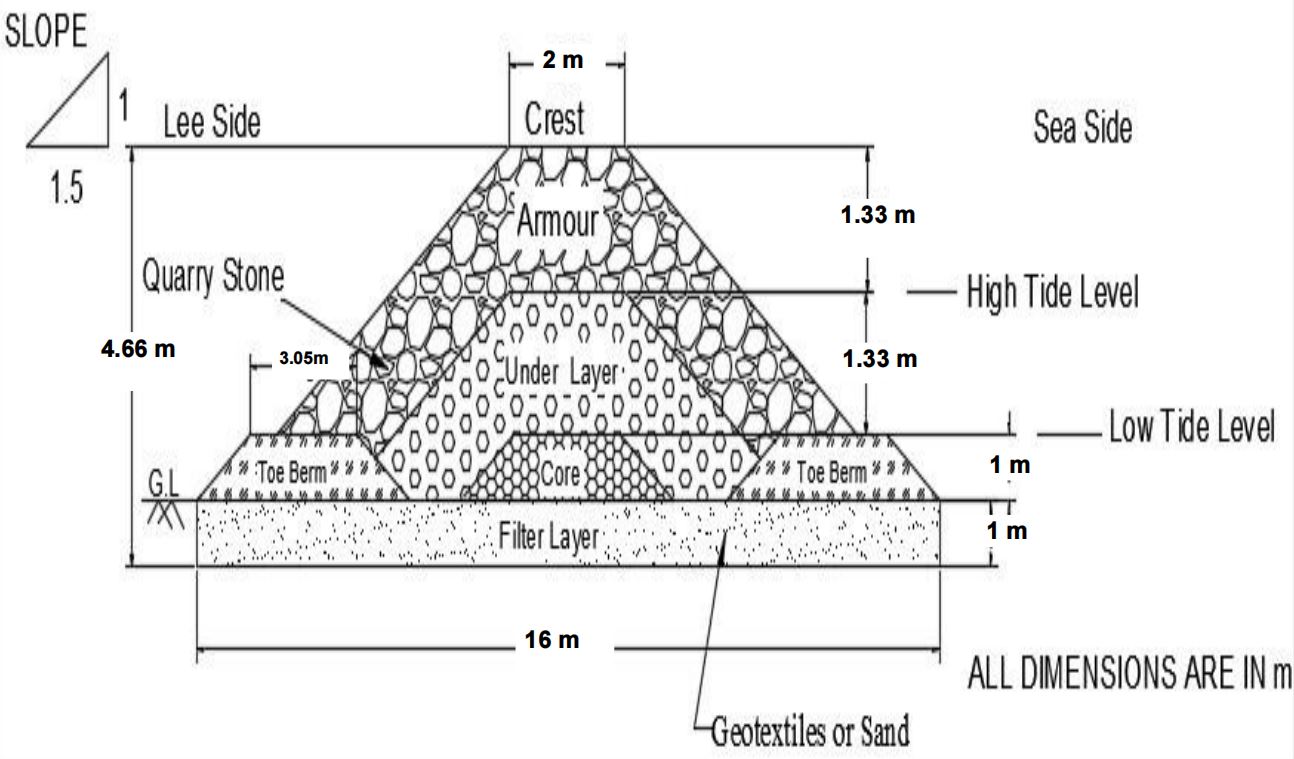
| 4 | Design of Rubble-Mound Shore Protection Structures (Quarrystone / Riprap Revetment & Seawall) Given shoreline site water levels (MLLW, MHHW, 50-year high water level, storm surge), seabed slope, and design wave height and period, check breaking wave conditions and armor suitability, and design a rubble-mound revetment or seawall (armor stone weight , layer thickness , wave runup & crest elevation, filter/underlayer, and toe protection) with a neat cross-sectional sketch. |
5 | SB / Topic 07 (Design Manual) (pp. 13–25, 92–97, 102–107); SB / Topic 07 (Revetment Graph) (p. 1); SB / Topic 08 (Seawall Graph) (p. 1) & Seawall Design.JPG |
2019 (Q7b), 2021 (Q5b), 2022 (Q5d), 2024 (Q5b), 2025 (Q5c) |
| 5 | Bangladesh Delta Plan (BDP) 2100: Delta Challenges, the 6 Hotspot Areas (Especially Coastal Zone Issues), and National / Hotspot Strategies & Measures Explain the need for an integrated plan (BDP 2100) and the challenges faced by Bangladesh as a delta. Define "Hotspots," list the 6 hotspot areas and their issues/challenges (particularly in the Coastal Zone), and discuss the national-level and hotspot-specific strategies and measures under BDP 2100. |
5 | SB / Topic 05 (BDP 2100) (pp. 4–41) | 2019 (Q8c), 2021 (Q7a), 2023 (Q2a, Q3b, Q4c), 2024 (Q7c), 2025 (Q6c) |
| 6 | Coastal Zone Nomenclature & Coastal Features / Landforms (Coastline, Tombolo, Barrier Spit, Barrier Island, Headland, Coastal Dune, Tidal Flats) Define and illustrate with neat sketches key coastal zone subzones and coastal morphological features, including Coastline, Tombolo, Barrier Spit, Barrier Island, Headland, Coastal Dune, and Tidal Flats, and explain how barrier islands and coastal dunes are formed. |
5 | SA / Lec 17-18 (pp. 5, 16–36); SB / Topic 01 (pp. 15–31) |
2019 (Q3d-ii), 2021 (Q1a), 2022 (Q2a), 2023 (Q1a), 2025 (Q1a) |
| 7 | Types, Objectives, Physical/Functional Characteristics & Design Criteria of Coastal Structures (Seawalls, Groins, Detached Breakwaters, Submerged Sills, Storm Surge Barriers) Name different types of coastal structures, state their objectives and principal functions, describe the physical and functional characteristics of seawalls, groins, detached breakwaters, submerged sills, and storm surge barriers, and state the design criteria for groins and breakwaters (length, cross-section, height, orientation, and layout). |
5 | SB / Topic 07 (LEC 16-17) (pp. 2–38); SB / Topic 07 (CEM Ch 3) (pp. 1–30) |
2019 (Q6a), 2022 (Q7d, Q8c), 2023 (Q2d-ii,iii), 2024 (Q5a), 2025 (Q8a) |
| 8 | Harbor Definition, Features / Components (Locked Basin, Harbor of Refuge, Littoral Drift Role & Remedies) & Harbor Layout Sketch (Including Madras Harbor with Outer Dock) Define a harbor (including harbor of refuge and locked basin), explain its various features/components and the role/remedies of littoral drift in harbor layout, and draw a neat sketch of a harbor layout plan (including how adverse natural challenges were addressed in the Madras Harbor layout with outer dock). |
5 | SB / Topic 03 (pp. 5–37); SB / Topic 04 (LEC 08-10) (pp. 31, 40) |
2019 (Q5c), 2021 (Q6a-iv, Q6b), 2022 (Q6a-iv,v, Q6c, Q6d), 2023 (Q2c), 2024 (Q6a) |
| 9 | Classification & Geometry of Different Types of Deltas (Shape & Depositional Controls) Compare and discuss with neat sketches and examples the geometry and classification of different types of deltas based on shape (Arcuate, Digitate/Bird's-foot, Cuspate) and depositional controls (River-dominated, Tide-dominated, Wave-dominated, Gilbert, and Estuarine deltas). |
5 | SB / Topic 05 (Deltas) (pp. 16–36) | 2019 (Q8b), 2021 (Q6a-ii, Q7c), 2022 (Q8b), 2023 (Q3c), 2024 (Q7b) |
| 10 | Coastal Processes, Wave / Tidal / Longshore Sediment Transport Processes & How Coastal Developments Affect Coastal Zone Processes Explain what natural coastal processes occur at a coast, how waves, tidal currents, and longshore currents transport material and change a beach (with sketches), how these processes affect human settlements, and how coastal developments affect coastal zone processes. |
5 | SB / Topic 04 (LEC 08-10) (pp. 2–35, 45–46); SB / Topic 02 (p. 57) |
2019 (Q8a), 2021 (Q7b), 2022 (Q7a, Q7c), 2023 (Q1c), 2025 (Q5a) |
| 11 | Wave Shoaling, Refraction & Breaking Calculation (Shoaled/Refracted Wave Height , Breaking Wave Height , Breaking Depth & Breaker Type) For a deep-water or intermediate-water wave propagating toward a sloping beach (with or without refraction), calculate the transformed wave height at shallower depths (), estimate the breaking wave height () and breaking water depth () using shoaling and breaking nomograms, and determine the breaker type. |
4 | SA / Lec 09-10 (pp. 4–24); SA / Lec 11-12 (pp. 8–19) |
2021 (Q2b), 2023 (Q7c), 2024 (Q4b), 2025 (Q3b) |
| 12 | Water Particle Displacement & Orbital Motion in Deep, Transitional, and Shallow Water Waves Differentiate between deep-water and shallow-water waves and show with neat sketches how water particle displacement from its mean position changes from circular orbits in deep water to elliptical paths in transitional and shallow water (along with local fluid velocity profiles). |
4 | SA / Lec 03 (pp. 12–13); SA / Lec 05-06 (pp. 7–13) |
2019 (Q2d, Q2e), 2023 (Q6c), 2024 (Q3a), 2025 (Q2a) |
| 13 | Wave Breaking Mechanism & Types of Breaking Waves (Spilling, Plunging, Collapsing, Surging) Explain why waves break, why wave breaking is much more common in shallow water than in deep water, and describe/sketch the different types of wave breaking (Spilling, Plunging, Collapsing, and Surging). |
4 | SA / Lec 03 (pp. 17–19); SA / Lec 11-12 (pp. 3–7) |
2019 (Q3d-i), 2022 (Q3b), 2023 (Q7a, Q7b-i,ii), 2024 (Q2a-iii,iv, Q3d) |
| 14 | Wave Transformation Processes: Necessity of Study, Wave Refraction, Wave Shoaling & Wave Diffraction Explain the necessity of studying wave transformation in coastal engineering, describe wave shoaling, wave refraction (including why wave refraction effects must be considered when siting a marine structure), and explain why wave diffraction occurs in shallow water waves. |
4 | SA / Lec 03 (pp. 15–16); SA / Lec 09-10 (pp. 2–26) |
2019 (Q1e), 2021 (Q2a), 2024 (Q2a-i,ii), 2025 (Q2c) |
| 15 | Failure Reasons & Failure Modes of Coastal Structures (Rubble-Mound Breakwaters, Rear-Side Overtopping Erosion, Rubble Foundations & Slab Elements) Discuss the reasons for the failure of coastal project elements and explain/sketch the mechanisms of failure modes relevant to rubble-mound breakwaters, modes of rear-side erosion of a sloping-front breakwater with capping due to wave overtopping, slip surface failure of rubble foundations, hydraulic instability and breakage of armor units, and pressure blowout of slab elements. |
4 | SB / Topic 07 (CEM Ch 3) (pp. 29, 31–48) | 2019 (Q7a), 2021 (Q5a-i,iii), 2022 (Q5c), 2025 (Q8b) |
| 16 | Typical Cross-Sections, Layers & Plan Layouts of Coastal Structures (Groins, Detached Breakwaters with Tombolo/Salient, Vertical-Front Seawall, Sea Dike & Conventional Rubble-Mound Breakwater) State the features of different layers of a conventional rubble-mound breakwater and what design factor governs Tombolo and Salient formation in detached breakwaters; illustrate with neat sketches: (i) typical beach configuration with groins, (ii) typical beach configurations with detached nearshore breakwaters (Tombolo & Salient), (iii) typical cross-section and layout of a sea dike, (iv) typical cross-section of a vertical-front seawall, and (v) conventional rubble-mound breakwater (with or without concrete superstructure). |
4 | SB / Topic 07 (LEC 16-17) (pp. 9, 14–16, 20–22, 31, 35–37); SB / Topic 07 (CEM Ch 3) (pp. 3, 6, 9, 11, 13, 18–20) |
2019 (Q6b), 2021 (Q5a-ii), 2022 (Q5a, Q5b), 2024 (Q8c) |
| 17 | Tide Prediction Methods: Non-Harmonic Constants (Lunitidal Interval, Age of Tide, Mean Establishment), Harmonic Constituents & Afternoon High-Water Time Calculation Explain the methods available for tide prediction, describe the non-harmonic constants (age of tide, lunitidal interval, mean establishment, vulgar establishment) and harmonic tidal constituents, and calculate the time of afternoon high water from Moon's transit time, mean establishment, and age of tides. |
4 | SB / Topic 06 (LEC 13-14) (pp. 14–30); SB / Topic 06 (LEC 14-15) (pp. 14–31) |
2021 (Q6a-v), 2022 (Q6a-iii), 2023 (Q3a, Q4b), 2025 (Q7b) |
| 18 | Group Velocity (): Definition, Relation with Wave Celerity () in Deep & Shallow Water, Energy Conservation Significance & Calculation Define group velocity (), write the relation between group velocity and wave celerity () for deep-water and shallow-water conditions, explain the significance of energy conservation in wave theory, and calculate at deep and shallow water depths. |
3 | SA / Lec 07-08 (pp. 2–6) | 2019 (Q4b), 2023 (Q5d), 2024 (Q1a, Q3c) |
| 19 | Subsurface Pressure Under Waves & Wave Height Determination from a Subsurface Pressure Gauge Explain subsurface pressure under a wave (static and dynamic components, pressure response factor ) and calculate the surface wave height () from the average maximum pressure and frequency recorded by an underwater pressure gauge. |
3 | SA / Lec 07-08 (pp. 7–11) | 2019 (Q3d-iv), 2023 (Q6b), 2024 (Q3b) |
| 20 | Comparison of Wave Theories: Pure Oscillatory (Airy / Linear) Waves vs. Finite-Amplitude (Stokes, Cnoidal, Solitary) Waves Differentiate between pure oscillatory waves and finite-amplitude waves, and compare Airy (linear), Stokes finite-amplitude, Cnoidal, and Solitary wave theories. |
3 | SA / Lec 03 (pp. 9–10); SA / Lec 07-08 (pp. 12–18) |
2022 (Q2b), 2023 (Q5b-ii), 2024 (Q1a) |
| 21 | Types of Daily Tidal Cycles (Semidiurnal, Diurnal & Mixed Tidal Cycles) with Graphical Representation Discuss and illustrate with graphical representations the different types of daily tidal cycles (semidiurnal, diurnal, and mixed tidal cycles, including the tidal cycle of Bangladesh). |
3 | SB / Topic 02 (pp. 12–16); SB / Topic 06 (LEC 13-14) (pp. 19–22) |
2021 (Q6a-i), 2023 (Q2b), 2024 (Q6b) |
| 22 | Newton's Static / Equilibrium & Dynamical Theories of Tide Generation & Relative Influence of the Moon and Sun on Earth's Tides Explain Newton's static (equilibrium) theory and the dynamical theory of tide generation (along with limitations of the equilibrium theory), and justify with a mathematical explanation why the Moon has a more pronounced effect in generating tides than the Sun. |
3 | SB / Topic 02 (pp. 4–11); SB / Topic 06 (LEC 13-14) (pp. 3–13) |
2019 (Q5b-i), 2022 (Q8d), 2025 (Q7a) |
| 23 | Tidal Levels (Height of Tide, Mean Sea Level, MHWS, MLWS, HAT, LAT), Chart Datum & Changes in Sounding Datum Define and explain standard tidal levels (height of tide, mean sea level [MSL], MHWS, MLWS, MHWN, MLWN, HAT, LAT), chart datum, and changes in sounding datum. |
3 | SB / Topic 02 (pp. 19–47) | 2019 (Q5b-ii), 2021 (Q6a-iii), 2022 (Q6a-i,ii) |
| 24 | Coastal Erosion: Definition, Erosion Processes & Hard/Soft Shoreline Protection Methods (Including Role of Wetlands) Define coastal erosion, explain the physical and chemical processes involved in coastal erosion (hydraulic action, abrasion, compressed air, attrition, corrosion/solution, wave refraction), and describe hard and soft methods to manage or reduce coastal erosion (including how wetlands and coastal vegetation protect the shoreline from erosion). |
3 | SB / Topic 04 (LEC 08-10) (pp. 6–17); SB / Topic 05 (BDP 2100) (pp. 4, 18, 25) |
2019 (Q6c), 2022 (Q8a), 2024 (Q8b) |
| 25 | Basic Assumptions to Derive Small-Amplitude (Airy / Linear) Surface Wave Theory State the basic physical and mathematical assumptions used to derive the Small-Amplitude Surface Wave Theory (Airy / Linear Wave Theory). |
2 | SA / Lec 04 (pp. 2–5) | 2019 (Q1b), 2023 (Q8c) |
| 26 | Definition of Basic Wave Parameters (Wave Height, Wave Number, Relative Depth, Wave Steepness & Sinusoidal Wave Profile) Define basic wave parameters including wave height (), wave number (), relative depth (), and wave steepness (), and describe the sinusoidal wave surface profile. |
2 | SA / Lec 03 (pp. 11–13) | 2019 (Q3d-iii, Q4c), 2023 (Q7b-iii) |
| 27 | Swell, Seiche & Tsunami Definitions and Differentiation with Respect to Water Level Variation Define and differentiate between Swell, Seiche (standing wave in an enclosed/semi-enclosed basin), and Tsunami with respect to wave generation and water level variation. |
2 | SA / Lec 03 (pp. 6–8, 20–29) | 2019 (Q1c), 2023 (Q5b-i) |
| 28 | Green's Law for Long / Tsunami Wave Shoaling: Theoretical Limit vs. Real Wave Fate & Tsunami Height Calculation Write down Green's Law (), show how wave height theoretically reaches infinity as depth approaches zero and explain the real fate of the wave (breaking), and apply Green's Law to calculate tsunami wave height in shallow water. |
2 | SA / Lec 09-10 (p. 6) | 2023 (Q8a), 2024 (Q4a) |
| 29 | Wave Setup and Wave Set-down: Mechanism, Significance in Coastal Water Rise / Surf-Zone Flooding & Numerical Calculation Define wave setup and set-down, explain why wave setup contributes significantly to coastal water rise and surf-zone flooding, and calculate the wave set-down at the breaker point () and wave setup at the still-water shoreline contour. |
2 | SA / Lec 11-12 (pp. 26–36) | 2023 (Q7b-iv, Q7d), 2025 (Q3c, Q4b) |
| 30 | Classification of Wave Force Problems by Type of Wave Action and by Structure Type Classify and illustrate wave force problems by type of wave action (non-breaking, breaking, and broken waves) and by type of coastal structure (pile-supported, wall, and rubble structures). |
2 | SA / Lec 13-14 (p. 2) | 2019 (Q4a), 2024 (Q4c) |
| 31 | Breaking & Broken Wave Forces and Moments on Vertical Walls (Minikin Pressure Diagram & Broken Wave Calculation) Draw the Minikin breaking wave pressure diagram with the toe moment equation, and calculate the total force and overturning moment exerted by a broken wave hitting a vertical breakwater. |
2 | SA / Lec 13-14 (pp. 19–29) | 2019 (Q1d), 2022 (Q2c) |
| 32 | Typical Cross-Shore Beach Profile Sketch & Salient Features Draw a neat sketch of a typical cross-shore beach profile (backshore, foreshore, nearshore, offshore, berm/crest, scarp, bar, trough, breaker/surf/swash zones) and identify all salient features. |
2 | SA / Lec 17-18 (pp. 4–5); SB / Topic 01 (pp. 21–22) |
2019 (Q2a), 2024 (Q4d) |
| 33 | Nearshore Waves and Current System (Littoral Processes, Longshore Currents & Rip Currents) Explain why waves are the prime movers for littoral processes at the shoreline, illustrate the waves and current system in a nearshore coastal zone with sketches, and explain why rip currents are dangerous to swimmers. |
2 | SA / Lec 11-12 (pp. 20–25); SA / Lec 17-18 (pp. 6–8) |
2022 (Q2a), 2023 (Q5a, Q6a) |
| 34 | Estuary Definition & Classification (Tide-Dominated, Wave-Dominated & Mixed Estuarine Systems) Define an estuary, differentiate between tide-dominated and wave-dominated estuaries, and explain the characteristics of mixed estuarine systems. |
2 | SA / Lec 17-18 (pp. 37–43) | 2019 (Q1f), 2025 (Q1a-ii, Q3a) |
| 35 | Definition of Coastal Engineering & Difference from Other Ocean-Related Studies Define Coastal Engineering and explain why it is different from other ocean-related studies. |
2 | SA / Lec 01 (pp. 2–5); SB / Topic 01 (p. 14) |
2019 (Q1a), 2023 (Q1a) |
| 36 | Physical Description of the Coastal Zone of Bangladesh & Cyclone / Storm Surge Management (CPP) State the physical description of the coastal zone of Bangladesh and explain how the coastal zone is managed against cyclones and storm surges (including the Cyclone Preparedness Programme, CPP). |
2 | SA / Lec 01 (pp. 10–16) (plus missing SA / Lec 15-16 for CPP) |
2021 (Q3a), 2022 (Q1a) |
| 37 | Tidal Flow & Tidal Characteristics of Bangladesh Define tidal flow and describe the tidal characteristics and tidal zones (microtidal, mesotidal, macrotidal) of the Bangladesh coast. |
2 | SB / Topic 02 (pp. 2–16, 48–58); SB / Topic 06 (LEC 13-14) (pp. 19–22) |
2019 (Q6c), 2023 (Q2b, Q4a) |
| 38 | Priming and Lagging of Tide & Spring and Neap Tides Explain with necessary figures: (i) Priming and lagging of tide, and (ii) Spring and neap tides. |
2 | SB / Topic 02 (pp. 8–11); SB / Topic 06 (LEC 13-14) (pp. 14–18) |
2023 (Q2d-i), 2025 (Q7c) |
| 39 | Potential Immersed Weight () and Volumetric Longshore Sediment Transport Rate () Calculation Using the energy flux method, calculate the potential immersed weight () and volumetric longshore sediment transport rate () along a beach for a given breaking wave height (), breaking wave angle (), and sediment fall velocity or transport coefficient (). |
2 | SB / Topic 04 (LEC 08-10) (pp. 26–39); SB / Topic 04 (Coastal Processes 252-253) (pp. 1–2) |
2024 (Q8a), 2025 (Q5b) |
| 40 | Process & Stages of Delta Formation and Sediment Deposition Layers (Topset, Foreset & Bottomset Beds) Discuss the process and three stages of delta formation with figures, and describe how gravel, sand, silt, and clay are deposited into different layers (topset, foreset, and bottomset beds, including flocculation) when a river flows into a sea. |
2 | SB / Topic 05 (Deltas) (pp. 4–15) | 2024 (Q7a), 2025 (Q6a, Q6b) |
| 41 | Secondary Coasts & Types of Marine Deposited Coasts Define secondary coasts and list the different types of marine deposited coasts under secondary coasts. |
1 | SA / Lec 02 (Missing folder; listed in SA / Lec 17-18 p. 44) | 2019 (Q2b) |
| 42 | Horizontal Wave Force on a Vertical Cylindrical Pile (Morison Equation) Write down the equation for horizontal force per unit length of a vertical cylindrical pile and identify all terms including the dimensionless terms. |
1 | SA / Lec 13-14 (p. 2 — pile-supported wave force topic; equation in earlier handout) | 2019 (Q3a) |
| 43 | Basic Information Needed for Oceanology and Their Applications What are the basic information needed for oceanology with their applications? |
1 | SA / Lec 01 (pp. 6–7) | 2019 (Q3b) |
| 44 | Distinguishing a Lake, a Sea, and an Ocean with Examples How do you distinguish a lake from a sea, and when is a sea called an ocean? Justify with appropriate examples. |
1 | SB / Topic 01 (pp. 2–13) | 2019 (Q5a) |
| 45 | The Shoreline as a Dynamic Interface in Coastal Morphological & Geological Processes "The shoreline is a dynamic interface" — explain the statement in the context of coastal morphological and geological processes. |
1 | SA / Lec 17-18 (pp. 2–3); SB / Topic 01 (p. 17) |
2022 (Q1b) |
| 46 | Short Notes on Ring of Fire and DART (Deep-Ocean Assessment and Reporting of Tsunamis) Write short notes on: (i) Ring of Fire, and (ii) DART. |
1 | SA / Lec 15-16 (Missing folder; listed in SA / Lec 17-18 p. 44) | 2022 (Q3a) |
| 47 | Statistical Wave Parameters from a Wave Train () From measured wave heights and periods of a wave train (34 waves), calculate: (i) Significant wave height and period (), (ii) One-tenth highest wave height and period (), and (iii) Root-mean-square wave height (). |
1 | SA / Lec 07-08 (pp. 19–25) | 2022 (Q3c) |
| 48 | Storm Surge Definitions, Langhaar-Shape Basin Procedure & Continental Shelf Storm Surge Calculation Define wind stress, moving wind field, triangular wind velocity, and fetch length; state the procedure for estimating storm surge height in enclosed water bodies having Langhaar shape; and compute the total storm surge height over a continental shelf from given wind speed, fetch, and bathymetry. |
1 | SA / Lec 15-16 (Missing folder; listed in SA / Lec 17-18 p. 44) | 2022 (Q4a, Q4b, Q4c) |
| 49 | Tidal Bore: Why It Occurs & Principal Characteristics Why does a tidal bore occur? Write down its principal characteristics. |
1 | SB / Topic 02 (pp. 49–50, 55) | 2022 (Q6b) |
| 50 | Input Datasets for Modeling Physical Processes in the Coastal Zone of Bangladesh List the input datasets required for modeling the physical processes in the coastal zone of Bangladesh (bathymetry/topography, tidal levels/constituents, wave climate, river discharge/sediment load, wind/cyclone tracks, shoreline data). |
1 | SB / Topic 04 (LEC 08-10) (pp. 2–5); SB / Topic 02 (pp. 48–58) |
2022 (Q7b) |
| 51 | Impacts of Sea Level Rise (SLR) and Adaptation Measures in Bangladesh Illustrate the impacts of sea level rise and what types of adaptation measures should be taken against sea level rise impacts in Bangladesh. |
1 | SB / Topic 01 (pp. 32–42) | 2023 (Q1b) |
| 52 | Differences Between Constructive and Destructive Waves Write down the differences between constructive and destructive waves. |
1 | SB / Topic 04 (LEC 08-10) (pp. 14–15) | 2024 (Q6c) |
| 53 | Environmental Conditions Required for Coral Survival Describe the conditions required for survival of coral in their environment. |
1 | SA / Lec 02 (Missing folder; listed in SA / Lec 17-18 p. 44) | 2025 (Q4c) |
| 54 | Differences Between Ports and Harbors Write down five differences between ports and harbors. |
1 | SB / Topic 03 (pp. 2–4, 25–27) | 2025 (Q8c) |
(All marks shown in parentheses reflect the exact printed margin marks on the question papers: 30 marks per question set, 180 full marks).
EWCE 471/SA/ — Lec 01 to Lec 17-18)SA / Lec 01 — Introduction to Coastal Engineering & Coastal Zone of Bangladesh| Slide Pages | Question / Concept Tested | Appeared Exams (Question & Marks) |
|---|---|---|
| pp. 2–5 | Define Coastal Engineering and explain why it is different from other ocean-related studies. | 2019 Q1a (5) 2023 Q1a (10, with coastal features) |
| pp. 6–7 | What are the basic information needed for oceanology with their applications? | 2019 Q3b (5) |
| pp. 10–16 | State the physical description of the coastal zone of Bangladesh (and how the Cyclone Preparedness Programme works during a coastal cyclone). | 2021 Q3a (10) 2022 Q1a (7) |
SA / Lec 03 — Wave Classification, Wave Generation, Sinusoidal Wave Parameters, Seiche & Tsunami| Slide Pages | Question / Concept Tested | Appeared Exams (Question & Marks) |
|---|---|---|
| pp. 6–8, 20–29 | Define and differentiate between Swell, Seiche, and Tsunami with respect to water level variation. | 2019 Q1c (5) 2023 Q5b-i (4) |
| pp. 9–10 | Differentiate between pure oscillatory waves and finite-amplitude waves. | 2022 Q2b (7) 2023 Q5b-ii (4) 2024 Q1a (6, with group velocity) |
| pp. 11–13 | Define basic wave parameters: Wave Height (), Wave Number (), Relative Depth (), Wave Steepness (), and Sinusoidal Wave Profile. | 2019 Q3d-iii (2.5), Q4c (10) 2023 Q7b-iii (2) |
| pp. 12–13 | Differentiate between deep-water and shallow-water waves and sketch water particle displacement / orbital paths from deep to shallow water. | 2019 Q2d (5), Q2e (5) 2023 Q6c (10) 2024 Q3a (8) 2025 Q2a (10) |
| pp. 15–16 | Overview of wave refraction, wave diffraction, and wave reflection. | 2019 Q1e (5) 2024 Q2a-i,ii (4) 2025 Q2c (5) |
| pp. 17–19 | Overview of why waves break and types of wave breaking (Spilling, Plunging, Collapsing, Surging). | 2019 Q3d-i (2.5) 2022 Q3b (7) 2023 Q7a (6), Q7b-i,ii (4) 2024 Q2a-iii,iv (4), Q3d (5) |
SA / Lec 04 — Derivation of Small-Amplitude (Airy / Linear) Surface Wave Theory| Slide Pages | Question / Concept Tested | Appeared Exams (Question & Marks) |
|---|---|---|
| pp. 2–5 | What are the basic assumptions to derive the Small-Amplitude Surface Wave Theory (Airy Wave Theory)? | 2019 Q1b (5) 2023 Q8c (5) |
SA / Lec 05-06 — Linear Wave Mechanics: Celerity, Wavelength, Particle Kinematics & Wave Energy/Power| Slide Pages | Question / Concept Tested | Appeared Exams (Question & Marks) |
|---|---|---|
| pp. 1–16 | Numerical Problem: Calculate wave celerity () and wavelength () across deep, transitional/intermediate, and shallow water depths for a given wave period (). | 2019 Q2c (8), Q4d (8) 2021 Q1b (20) 2022 Q1c (16) 2023 Q5c (10) 2024 Q2b (10), Q2c (12) 2025 Q2b (15) |
| pp. 7–13 | Show with neat sketches how water particle displacement and local fluid velocity profiles vary in deep, transitional, and shallow water waves. | 2019 Q2d (5), Q2e (5) 2023 Q6c (10) 2024 Q3a (8) 2025 Q2a (10) |
| pp. 7–24 | Numerical Problem: Calculate local horizontal and vertical fluid velocities (), accelerations (), orbital displacements (), total wave energy (), and wave power () at specified depth and phase angle . | 2019 Q2c (8) 2021 Q1b (20) 2022 Q1c (16) 2023 Q5c (10) 2024 Q2c (12) |
SA / Lec 07-08 — Group Velocity, Subsurface Pressure, Finite-Amplitude Wave Theories & Wave Train Statistics| Slide Pages | Question / Concept Tested | Appeared Exams (Question & Marks) |
|---|---|---|
| pp. 2–6 | Define group velocity (), state its relation with wave celerity () for deep and shallow water, explain the significance of energy conservation in wave theory, and calculate at given depths. | 2019 Q4b (7) 2023 Q5d (6) 2024 Q1a (6, with wave theories), Q3c (5) |
| pp. 7–11 | Define subsurface pressure and calculate surface wave height () from the average maximum dynamic pressure and wave frequency recorded by a subsurface pressure gauge. | 2019 Q3d-iv (2.5) 2023 Q6b (10) 2024 Q3b (12) |
| pp. 12–18 | Compare Airy (linear), Stokes finite-amplitude, Cnoidal, and Solitary wave theories. | 2022 Q2b (7) 2023 Q5b-ii (4) 2024 Q1a (6) |
| pp. 19–25 | Numerical Problem: From measured wave heights and periods of a wave train (34 waves), determine , and . | 2022 Q3c (16) |
SA / Lec 09-10 — Wave Transformation: Shoaling, Green's Law, Refraction & Diffraction| Slide Pages | Question / Concept Tested | Appeared Exams (Question & Marks) |
|---|---|---|
| pp. 2–26 | Necessity of studying wave transformation; wave shoaling; wave refraction (and why refraction effects must be considered when siting a marine structure); and why wave diffraction occurs in shallow water waves. | 2019 Q1e (5) 2021 Q2a (10) 2024 Q2a-i,ii (4) 2025 Q2c (5) |
| p. 6 | Write down Green's Law, explain how wave height theoretically approaches infinity as depth approaches zero vs. the real fate of the wave (breaking), and calculate tsunami wave height in shallow water. | 2023 Q8a (5) 2024 Q4a (6) |
| pp. 4–24 | Numerical Problem: Calculate shoaled and refracted wave height () at intermediate/shallow depths for a wave propagating toward shore. | 2021 Q2b (20) 2023 Q7c (12) 2024 Q4b (15) 2025 Q3b (20) |
SA / Lec 11-12 — Wave Breaking, Surf-Zone Currents, Wave Setup / Set-down & Wave Runup| Slide Pages | Question / Concept Tested | Appeared Exams (Question & Marks) |
|---|---|---|
| pp. 3–7 | Explain why waves break, why wave breaking is much more common in shallow water than in deep water, and describe/sketch the four types of breaking waves (Spilling, Plunging, Collapsing, Surging). | 2019 Q3d-i (2.5) 2022 Q3b (7) 2023 Q7a (6), Q7b-i,ii (4) 2024 Q2a-iii,iv (4), Q3d (5) |
| pp. 8–19 | Numerical Problem: Using shoaling and breaking nomograms, estimate breaking wave height (), breaking water depth (), and breaker type on a given beach slope . | 2021 Q2b (20) 2023 Q7c (12) 2024 Q4b (15) 2025 Q3b (20) |
| pp. 20–25 | Illustrate the nearshore waves and current system (longshore current, rip current) and explain why rip currents are dangerous to swimmers. | 2022 Q2a (7, first part) 2023 Q5a (6), Q6a (10) |
| pp. 26–36 | Explain wave setup and set-down and why wave setup contributes to coastal water rise and surf-zone flooding; calculate wave set-down at breaking () and wave setup at the still-water shoreline contour. | 2023 Q7b-iv (2), Q7d (4) 2025 Q3c (5), Q4b (15) |
SA / Lec 13-14 — Wave Forces and Moments on Vertical Walls (Non-Breaking, Breaking & Broken Waves)| Slide Pages | Question / Concept Tested | Appeared Exams (Question & Marks) |
|---|---|---|
| p. 2 | Classify and illustrate wave force problems by type of wave action and by type of coastal structure (and identify terms in the horizontal wave force equation on a vertical cylindrical pile). | 2019 Q3a (5), Q4a (5) 2024 Q4c (3) |
| pp. 3–18 | Explain the pressure distribution of a non-breaking wave on a vertical wall and calculate the forces () and overturning moments () when the wave crest or wave trough hits a vertical wall / emerged breakwater (using the Miche–Rundgren / Sainflou nomograms). | 2019 Q3c (10) 2021 Q3b (20) 2023 Q8b (20) 2024 Q1b (24) 2025 Q1b (21), Q4a (10) |
| pp. 19–29 | Draw the Minikin breaking wave pressure diagram with the toe moment equation (2019 Q1d), and calculate the total force and overturning moment for a broken wave hitting a vertical breakwater (2022 Q2c). | 2019 Q1d (5) 2022 Q2c (16) |
SA / Lec 17-18 — Coastal Morphology, Cross-Shore Beach Profile, Coastal Landforms & EstuariesSA lectures (p. 44).| Slide Pages | Question / Concept Tested | Appeared Exams (Question & Marks) |
|---|---|---|
| pp. 2–3 | "The shoreline is a dynamic interface" — explain the statement in the context of coastal morphological and geological processes. | 2022 Q1b (7) |
| pp. 4–5 | Draw a neat sketch of a typical cross-shore beach profile and identify all salient features. | 2019 Q2a (6) 2024 Q4d (6) |
| pp. 6–8 | Explain why waves are the prime movers for littoral processes at the shoreline. | 2023 Q5a (6), Q6a (10) |
| pp. 5, 16–36 | Define and sketch coastal zone subzones and coastal morphological features (Coastline, Tombolo, Barrier Spit, Barrier Island, Headland, Coastal Dune, Tidal Flats) and explain how barrier islands and coastal dunes are formed. | 2019 Q3d-ii (2.5) 2021 Q1a (10) 2022 Q2a (7, second part) 2023 Q1a (10) 2025 Q1a-i,iii (6) |
| pp. 37–43 | Define an estuary, differentiate between tide-dominated and wave-dominated estuaries, and explain the characteristics of mixed estuarine systems. | 2019 Q1f (5) 2025 Q1a-ii (3), Q3a (5) |
EWCE 471/SB/ — Topic 01 to Topic 08)SB / Topic 01 — Introduction to Coastal Engineering, Sea vs. Ocean, Coast & Coastal Features, and Sea Level Rise (SLR)| Slide Pages | Question / Concept Tested | Appeared Exams (Question & Marks) |
|---|---|---|
| pp. 2–13 | How do you distinguish a lake from a sea, and when is a sea called an ocean? Justify with appropriate examples. | 2019 Q5a (6) |
| pp. 14–31 | Define Coastal Engineering and explain with sketches key coastal features (Coastline, Tombolo, Barrier Spit, Barrier Island, Headland). | 2023 Q1a (10) |
| pp. 32–42 | Illustrate the impacts of Sea Level Rise (SLR) and what types of adaptation measures should be taken against SLR impacts in Bangladesh. | 2023 Q1b (15) |
SB / Topic 02 — Tides, Tidal Cycles, Tidal Datum Levels, Tidal Bore & Tidal Characteristics of Bangladesh| Slide Pages | Question / Concept Tested | Appeared Exams (Question & Marks) |
|---|---|---|
| pp. 12–16 | Discuss and illustrate with graphical representations the different types of daily tidal cycles (semidiurnal, diurnal, and mixed tidal cycles). | 2021 Q6a-i (3) 2023 Q2b (10) 2024 Q6b (12) |
| pp. 19–47 | Define and explain standard tidal levels (Height of Tide, Mean Sea Level [MSL], MHWS, MLWS, MHWN, MLWN, HAT, LAT), chart datum, and changes in sounding datum. | 2019 Q5b-ii (7) 2021 Q6a-iii (3) 2022 Q6a-i,ii (2) |
| pp. 49–50, 55 | Why does a tidal bore occur? Write down its principal characteristics. | 2022 Q6b (5) |
| pp. 2–16, 48–58 | Define tidal flow and describe the tidal characteristics of the Bangladesh coast. | 2019 Q6c (7, tidal characteristics) 2023 Q2b (10), Q4a (10) |
SB / Topic 03 — Ports and Harbors| Slide Pages | Question / Concept Tested | Appeared Exams (Question & Marks) |
|---|---|---|
| pp. 5–37 | Define a harbor (including harbor of refuge and locked basin), explain its various features/components and the role/remedies of littoral drift in harbor layout, and draw a neat sketch of a harbor layout plan (including how adverse natural challenges were addressed in the Madras Harbor layout with outer dock). | 2019 Q5c (10) 2021 Q6a-iv (3), Q6b (15) 2022 Q6a-iv,v (2), Q6c (5), Q6d (15) 2023 Q2c (6) 2024 Q6a (12) |
| pp. 2–4, 25–27 | Write down five differences between ports and harbors. | 2025 Q8c (10) |
SB / Topic 04 — Coastal Processes, Coastal Erosion & Longshore/Cross-Shore Sediment Transport| Slide Pages | Question / Concept Tested | Appeared Exams (Question & Marks) |
|---|---|---|
LEC 08-10 pp. 2–35, 45–46 |
Explain what natural coastal processes occur at a coast, how waves, tidal currents, and longshore currents transport material and change a beach (with sketches), how they affect human settlements, and how coastal developments affect coastal zone processes. | 2019 Q8a (7) 2021 Q7b (10) 2022 Q7a (5), Q7c (5) 2023 Q1c (5) 2025 Q5a (5) |
LEC 08-10 pp. 2–5 |
List the input datasets for modeling the physical processes in the coastal zone of Bangladesh. | 2022 Q7b (5) |
LEC 08-10 pp. 6–17 |
Define coastal erosion, explain the processes involved in coastal erosion, and describe hard and soft methods to manage or reduce coastal erosion (including how wetlands protect the shoreline from erosion). | 2019 Q6c (8, coastal erosion) 2022 Q8a (5) 2024 Q8b (10) |
LEC 08-10 pp. 14–15 |
Write down the differences between constructive and destructive waves. | 2024 Q6c (6) |
LEC 08-10 pp. 26–39;Coastal Processes_252-253.pdf pp. 1–2 |
Numerical Problem: Calculate the potential immersed weight () and volumetric longshore sediment transport rate () for given breaking wave height , breaking angle , and fall velocity / coefficient . | 2024 Q8a (8) 2025 Q5b (10) |
SB / Topic 05 — Deltas and Their Characteristics & Bangladesh Delta Plan (BDP) 2100LEC 11-12): Definition and conditions required for delta formation; process and 3 stages of delta formation; differential sediment deposition (gravel, sand, silt, clay via flocculation) into Topset, Foreset, and Bottomset beds; classification and geometry of deltas by shape (Arcuate, Digitate / Bird's-foot, Cuspate) and by depositional controls (River-dominated, Tide-dominated, Wave-dominated, Gilbert, and Estuarine deltas) with examples; Ganges–Brahmaputra–Meghna (GBM) delta characteristics.LEC 13): Need for an integrated plan (BDP 2100) and natural/climatic challenges faced by Bangladesh as a delta; BDP 2100 vision, mission, 3 higher-level national goals, and 6 specific goals; definition of "Hotspots" and the 6 Hotspot Areas (Coastal Zone, Barind & Drought-Prone Areas, Haor & Flash-Flood Areas, Chattogram Hill Tracts, River Systems & Estuaries, Urban Areas); key issues/challenges in the Coastal Zone hotspot; National-level and Coastal Zone Hotspot strategies and sub-strategies.| Slide Pages | Question / Concept Tested | Appeared Exams (Question & Marks) |
|---|---|---|
Deltas pp. 4–15 |
Discuss the process and three stages of delta formation with figures, and describe how gravel, sand, silt, and clay are deposited into different layers (topset, foreset, and bottomset beds) when a river flows into a sea. | 2024 Q7a (12) 2025 Q6a (10), Q6b (12) |
Deltas pp. 16–36 |
Compare and discuss with sketches and examples the geometry and classification of different types of deltas (Arcuate, Bird's-foot/Digitate, Cuspate; River-dominated, Tide-dominated, Wave-dominated, Gilbert, Estuarine). | 2019 Q8b (8) 2021 Q6a-ii (3), Q7c (10) 2022 Q8b (5) 2023 Q3c (8) 2024 Q7b (8) |
BDP 2100 pp. 4–41 |
Explain the need for an integrated plan (BDP 2100) and the challenges faced by Bangladesh as a delta; define "Hotspots," list the 6 hotspot areas and their issues (especially Coastal Zone issues), and discuss the national-level and hotspot-specific strategies under BDP 2100. | 2019 Q8c (15) 2021 Q7a (10) 2023 Q2a (10), Q3b (15), Q4c (10) 2024 Q7c (10) 2025 Q6c (8) |
SB / Topic 06 — Tidal Theories and Tide Prediction| Slide Pages | Question / Concept Tested | Appeared Exams (Question & Marks) |
|---|---|---|
LEC 13-14 pp. 3–13;LEC 14-15 pp. 3–14 |
Explain Newton's static (equilibrium) theory and the dynamical theory of tide generation (and limitations of the equilibrium theory), and justify with a mathematical explanation why the Moon has a greater influence on Earth's tides than the Sun. | 2019 Q5b-i (7) 2022 Q8d (15) 2025 Q7a (10) |
LEC 13-14 pp. 14–18 |
Explain with necessary figures: (i) Priming and lagging of tide, and (ii) Spring and neap tides. | 2023 Q2d-i (2) 2025 Q7c (10) |
LEC 13-14 pp. 14–30;LEC 14-15 pp. 14–31 |
Explain the methods available for tide prediction (non-harmonic constants including lunitidal interval, and harmonic constituents) and calculate the time of afternoon high water from Moon's transit time, mean establishment, and age of tides. | 2021 Q6a-v (3) 2022 Q6a-iii (1) 2023 Q3a (7), Q4b (10) 2025 Q7b (10) |
SB / Topic 07 — Types, Functions, Failure Modes & Design of Coastal Structures (Revetments, Seawalls, Breakwaters & Groins)| Slide / Manual Pages | Question / Concept Tested | Appeared Exams (Question & Marks) |
|---|---|---|
LEC 16-17 pp. 2–38;CEM Ch 3 pp. 1–30 |
Name different types of coastal structures, state their objectives and principal functions, describe physical and functional characteristics of seawalls, groins, detached breakwaters, submerged sills, and storm surge barriers, and state design criteria for groins and breakwaters. | 2019 Q6a (7) 2022 Q7d (15), Q8c (5) 2023 Q2d-ii,iii (4) 2024 Q5a (10) 2025 Q8a (10) |
LEC 16-17 pp. 9, 14–16, 20–22, 31, 35–37;CEM Ch 3 pp. 3, 6, 9, 11, 13, 18–20 |
State the features of different layers of a conventional rubble-mound breakwater and what design factor governs Tombolo and Salient formation; sketch typical beach configurations with groins and detached breakwaters, typical cross-section and layout of a sea dike, typical cross-section of a vertical-front seawall, and a conventional rubble-mound breakwater. | 2019 Q6b (8) 2021 Q5a-ii (3.33) 2022 Q5a (5), Q5b (5) 2024 Q8c (12) |
CEM Ch 3 pp. 29, 31–48 |
Discuss reasons for the failure of coastal project elements and explain/sketch failure modes of rubble-mound breakwaters, rear-side erosion of a sloping-front breakwater with capping due to wave overtopping, rubble foundations (slip surface), armor units, and slab elements (pressure blowout). | 2019 Q7a (10) 2021 Q5a-i,iii (6.67) 2022 Q5c (5) 2025 Q8b (10) |
EM 1110-2-1614 pp. 13–25, 92–97, 102–107;Graph for Revetment Design.pdf p. 1 |
Design Problem: Design a quarrystone/riprap revetment (2021 Q5b, 2022 Q5d, 2024 Q5b) or rubble-mound seawall (2019 Q7b, 2025 Q5c) for a given shoreline site and draw its cross-section. | 2019 Q7b (20) 2021 Q5b (20) 2022 Q5d (15) 2024 Q5b (20) 2025 Q5c (15) |
SB / Topic 08 — Design of Rubble-Mound Seawall (Design Graphs & Cross-Section)SB / Topic 07).| File / Page | Question / Concept Tested | Appeared Exams (Question & Marks) |
|---|---|---|
Graph for Seawall Design.pdf p. 1;Seawall Design.JPG |
Design Problem: Design a rubble-mound seawall to protect a shoreline against wave attack (armor weight, thickness, crest elevation, underlayer, core, filter, and toe protection) and sketch the cross-section. | 2019 Q7b (20) 2025 Q5c (15) (and closely related to revetment design in 2021 Q5b, 2022 Q5d, 2024 Q5b) |
SA Lecture Folders Lec 02 & Lec 15-16 / Earlier Handouts)As shown on page 44 of SA/Lec 17-18/EWC471_lecture 17 and 18.pdf, Lecture #2 (Coastal landforms, coastal diversity, coral reefs) and Lectures #15–16 (Storm surge and Tsunami) belong to the Section A (SA) curriculum, though their slide folders (Lec 02 and Lec 15-16) are not included in EWCE 471/SA/.
| Exam & Question | Question Text | Syllabus Attribution |
|---|---|---|
| 2019 Q2b (6) | Define secondary coasts. List up the different types of marine deposited coasts under secondary coasts. | SA / Lec 02 (Missing folder: Coastal Landforms & Shepard's Primary/Secondary Coast Classification) |
| 2019 Q3a (5) | Write down the equation for horizontal force per unit length of a vertical cylindrical pile and identify all the terms including the dimensionless terms. | SA / Lec 13-14 (Pile-supported wave force / Morison equation — listed on p. 2 of Lec 13-14, detailed equation in earlier handout) |
| 2022 Q1a (7) | State the physical description of the coastal zone of Bangladesh. How does the Cyclone Preparedness Programme work during a coastal cyclone? | SA / Lec 01 & SA / Lec 15-16 (Cyclone Preparedness Programme — CPP & Storm Surge Management) |
| 2022 Q3a (7) | Write short notes on: (i) Ring of Fire, and (ii) DART. | SA / Lec 15-16 (Missing folder: Storm Surge and Tsunami) |
| 2022 Q4a, Q4b, Q4c (30) | (a) Define wind stress, moving wind field, triangular wind velocity, and fetch length (7). (b) State the procedure for estimating storm surge height in enclosed water bodies having Langhaar shape (7). (c) Compute the total storm surge height over a continental shelf from given wind speed, fetch, and bathymetry (16). |
SA / Lec 15-16 (Missing folder: Storm Surge and Tsunami) |
| 2025 Q4c (5) | Describe the conditions required for survival of coral in their environment. | SA / Lec 02 (Missing folder: Coastal Landforms & Coral Reefs — listed on p. 44 of Lec 17-18) |